
Comparison of Achievement Before and After Studying the Basics of Force and Moment Mechanics using Engineering Mechanics Teaching Documents
DOI:
https://doi.org/10.14456/jriie.2025.8Keywords:
แรงและโมเมนต์, นักศึกษา, กลศาสตร์วิศวกรรม, ผลสัมฤทธิ์ทางการเรียน, อุตสาหกรรมAbstract
Engineering Mechanics is a fundamental course essential for developing a deep understanding of forces and moments, which are critical for analyzing structural systems
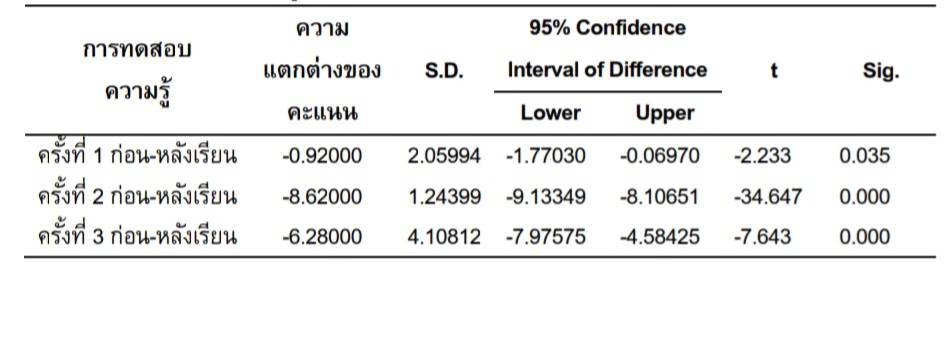
in engineering. However, due to the low level of comprehension among students, this study aims to compare students’ learning achievement before and after studying the fundamental concepts of forces and moments using a specially designed instructional document for Course: Engineering Mechanics with first-year undergraduate students. This research employed a quantitative methodology using a One-Group Pretest-Posttest Design, involving 31 first-year undergraduate students in the Department of Civil Technical Education, Faculty of Technical Education, Rajamangala University of Technology Isan, Khon Kaen Campus. The data were collected through three sets of pretest and posttest assessments. Analysis using the Paired Sample t-test revealed that the average pretest score was 2.85, while the posttest average was 8.14, showing a statistically significant difference at the .05 level in all three tests, especially in Test 2 and
Test 3, where posttest scores increased markedly. The findings indicate that instructional materials tailored to the specific learning characteristics of vocational students can effectively enhance structural understanding and simplify complex mechanics content. Additionally,
they promote hands-on learning and help students meaningfully connect theoretical concepts to real-world situations. This research contributes academically by proposing an effective instructional strategy suited to vocational students and supports educational quality in foundational engineering subjects.
Downloads
References
Hibbeler, R. C. (2022). Engineering Mechanics: Statics (15th). Pearson Education.
วุฒิชัย ปูคะธรรม, เจริญวิชญ์ สมพงษ์ธรรม และ ชญานิธิ แบร์ตี้. (2563). ผลการจัดการเรียนรู้รายวิชากลศาสตร์ หน่วยงานและพลังงาน โดยใช้ชุดกิจกรรมการจัดการเรียนรู้แบบสืบเสาะหาความรู้ (5E) ของนักเรียนชั้นมัธยมศึกษาปีที่ 4 โรงเรียนวิทยาศาสตร์จุฬาภรณราชวิทยาลัย มุกดาหาร. วารสารนวัตกรรมการศึกษาและการวิจัย, 4(3), 275–289. สืบค้น จาก https://so03.tci-thaijo.org/index.php/jeir/article/view/247778
Wongjinda, W., Srisumoungklounggoon, T. ., Nilnont, W. ., Phitakwinai, S. ., & Charoensuk, N. . (2023). The Development of Learning Package on Mechanics of Materials for Mechanical Engineering Students. Interdisciplinary Academic and Research Journal, 3(5), 49–62. https://doi.org/10.14456/iarj.2023.239 (inThai)
Sopha, P., Kumphong, J., Amornpinyo, P., Jantarakot, S., Bubpi, A., & Phonkasi, S. (2024). Production of Learning Materials Using Computer Assisted Instruction Technology : Case Study on the Topic of the Road History. Journal of Graduate MCU KhonKaen Campus, 11(3), 108-119. (inThai)
Kumphong, J., Narongsak, P., Sirisripetch, Y., Wichaiyo, T., Srichandum, S., Tho-In, T., ... & Singhjam, P. (2024). Production of Learning Materials Using 3D of Augmented Reality (AR) Technology to Simulate Pile Foundation Structure. Journal of Graduate MCU KhonKaen Campus, 11(2), 239-248. (inThai)
Chaiphia, E. ., Hongkong, S. ., & Siricharoenpanich, A. . (2020). A STUDY OF LEARNING ACHIEVEMENT ON WEB-BASED LEARNING LESSON OF MOTORCYCLE PRACTICE FOR UNDERGRADUATE STUDENTS . Journal of Industrial Education, 19(2), 60–68. retrieved from https://ph01.tci-thaijo.org/index.php/JIE/article/view/240636 (inThai)
Beer, F. P., Johnston, E. R., & Mazurek, D. F. (2015). Vector Mechanics for Engineers: Statics (11th). McGraw-Hill Education.
Herrmann, L., & Kollmannsberger, S. (2024). Deep learning in computational mechanics: a review. Computational Mechanics, 74(2), 281-331.
Brunton, S. L. (2021). Applying machine learning to study fluid mechanics. Acta Mechanica Sinica, 37(12), 1718-1726.
ศานิตย์ ศรีคุณ และ ทัศนีย์ บุญเติม. (2558). การตรวจสอบความตรงเชิงทฤษฎีของแบบทดสอบทักษะกระบวนการทางวิทยาศาสตร์. วารสารศึกษาศาสตร์มหาวิทยาลัยขอนแก่น, 38(3), 20-33.
Kumphong, J., Satiennam, T., Satiennam, W., & Tirapat, S. (2019). Change of motorcycle speed under speed enforcement camera on urban arterial in khon kaen city, Thailand. GEOMATE Journal, 16(56), 159-164.
วรัตถ์พัชร์ ทวีเจริญกิจ และวิชิต สุรัชเรืองชัย (2562).การพัฒนารูปแบบการเรียนการสอนเพื่อส่งเสริมทักษะในการคิดแก้ปัญหาของนักเรียนอาชีวศึกษาตามแนวคิดทฤษฎีการสร้างความรู้.วารสารราชพฤกษ์, 17(1). 86-93.
Downloads
Published
How to Cite
Issue
Section
License
Copyright (c) 2025 Journal of Research and Innovation in Industrial Education

This work is licensed under a Creative Commons Attribution-NonCommercial-NoDerivatives 4.0 International License.
This article is published under a Creative Commons Attribution-NonCommercial-NoDerivatives 4.0 International License (CC BY-NC-ND 4.0), which allows others to share the article with proper attribution to the authors and prohibits commercial use or modification. For any other reuse or republication, permission from the journal and the authors is required.