
The Development of an Integrated Learning Model to Enhance Startup Business Skills for Industrial Arts Students at Nakhon Si Thammarat Rajabhat University.
DOI:
https://doi.org/10.14456/jriie.2025.10Keywords:
Learning development, startup business, learning behaviorAbstract
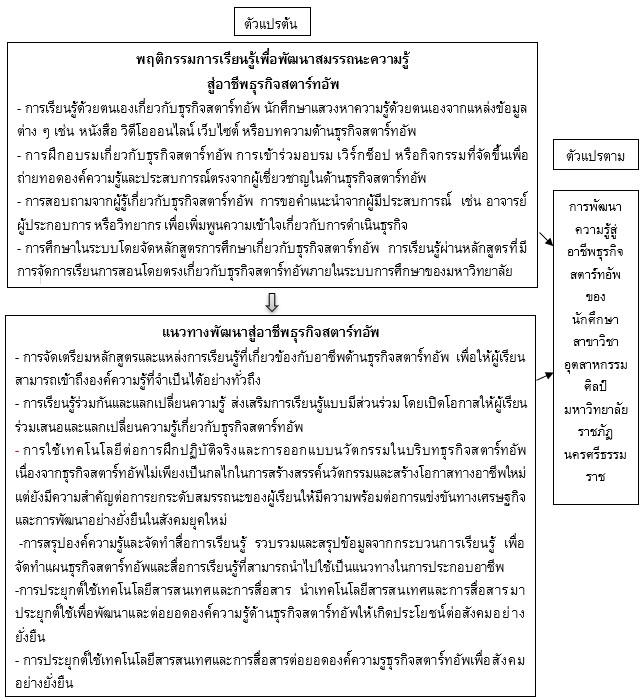
This research aimed to: 1) study learning behaviors for developing entrepreneurial competency among students in the Industrial Arts program at Nakhon Si Thammarat Rajabhat-University, and 2) explore guidelines for developing startup entrepreneurship. The sample group consisted of 53 first- to third-year students in the Industrial Arts program, Faculty of Industrial Technology, during the second semester of the 2024 academic year. The research findings revealed that: Overall, students' learning behaviors for developing knowledge competencies toward startup careers were at a high level (Mean = 3.66, S.D. = 1.05). The most prominent behavior was self-directed learning (Mean = 3.73, S.D. = 1.06), followed by formal curriculum-based learning
(Mean = 3.67, S.D. = 1.12), and consulting with knowledgeable individuals (Mean = 3.67,
S.D. = 1.12). In terms of development guidelines for startup careers, the overall level was
the highest (Mean = 3.89, S.D. = 1.09). The most emphasized approach was hands-on practice in technology and startup innovation (Mean = 3.96, S.D. = 1.13), followed by the application of ICT
to extend knowledge for social benefit (Mean = 3.91, S.D. = 1.06), and collaborative learning through presenting startup business ideas (Mean = 3.89, S.D. = 1.05).
Downloads
References
นัศรีน อารยสมัย และคณะ. (2564). การพัฒนากิจกรรมสตาร์ทอัพด้วยการจัดการเรียนรู้แบบผสมผสาน เพื่อเสริมสร้างความเป็นผู้ประกอบการ สำหรับนักเรียนชั้นมัธยมศึกษาปีที่ 2 โรงเรียนตรัง รังสฤษฎ์ จังหวัดตรัง.วารสารศึกษาศาสตร์ปริทัศน์, 35(3), 142-153.
สมพร ปานดำ. (2562). แนวทางการพัฒนาศูนย์บ่มเพาะผู้ประกอบการอาชีวศึกษาสู่การสร้างผู้ประกอบการใหม่. กรุงเทพฯ:วิทยาลัยป้องกันราชอาณาจักร หลักสูตร วปอ. รุ่นที่ 62, 2562.
อธิวัฒน์ รัตนวงศ์แข และ อรรควิช จารึกจารีต. (2560). ความแตกต่างของบุคคลด้านรูปแบบการเรียนรู้. วารสารจิตวิทยา มหาวิทยาลัยเกษมบัณฑิต, 7(2), 66-74.
วิชญะ น้อยมาลา. (2564, มกราคม-เมษายน). ทักษะจําเป็นของการทํางานในศตวรรษที่ 21วารสารวิชาการรัตนบุศย์, 3(1), 45-56.
ศิรินันท์ เหลืองอภิรมณ์.(2564). ธุรกิจดิจิทัลผ่านสื่อสังคมออนไลน์. กรุงเทพฯ:วี.พริ้นท์(1991)
Stoica, O., Raman, A. & Rusu, V. (2020). The nexus between entrepreneurship and economic growth: A comparative analysis on groups of countries. Sustainability, 12(1186), 1-19
Innovative Startup: What Is the New Innovative Business Development Program, Srinakharinwirot University, Startup.
Kim, S. W., & Joo, S.-J. (2021). Environmental uncertainty, strategic orientation and quality management: A study of Korean SMEs. Sustainability, 13(4), 2214.
Akbari, R., Hadaegh, A., & Jalali, S. A. (2020). A digital transformation reference model for smart city development. Journal of Urban Technology, 27(1), 77-98.
Ries, E. (2011). The lean startup: How today’s entrepreneurs use continuous innovation to create radically successful business. New York: Crown Business.
Blank, Steve. (2010). What A Startup? First Principles.Retrieved April 12, 2019, from https://steveblank.com/2010/01/25/whats-a-สตาร์ทอัพ-first-principles/
Janakova, H. (2015). The success prediction of the technological start-up projects in Slovakconditions. Procedia Economics and Finance, 34, 73-80.
Potjanajaruwit, P. & Girdwichai, L. (2019). Creative innovation of startup business in Thailand 4.0 Era. Journal of International Studies, 12(3), 222-231.
Felix et al. (2016). Elements of Strategic Social Media Marketing: A Holistic Framework. Journal of Business Research, 70(1), 118 -126.
สมพิศ ทองปาน. (2559). HR เชิงรุกในยุคของการเปลี่ยนแปลง. วารสารบัณฑิตศึกษา มหาวิทยาลัยราชภัฏวไลยอลงกรณ์ในพระบรมราชูปถัมภ์, 10(3), 254-255.
Downloads
Published
How to Cite
Issue
Section
License
Copyright (c) 2025 Journal of Research and Innovation in Industrial Education

This work is licensed under a Creative Commons Attribution-NonCommercial-NoDerivatives 4.0 International License.
This article is published under a Creative Commons Attribution-NonCommercial-NoDerivatives 4.0 International License (CC BY-NC-ND 4.0), which allows others to share the article with proper attribution to the authors and prohibits commercial use or modification. For any other reuse or republication, permission from the journal and the authors is required.