
การพัฒนาสมรรถนะผู้ประกอบการด้วยการเรียนรู้แบบ WIL บูรณาการ yPAR: โครงการข้าวเหนียวดำฐานชุมชน
คำสำคัญ:
การเรียนรู้ผ่านการทำงานจริง, การวิจัยเชิงปฏิบัติการแบบมีส่วนร่วมของเยาวชน, ข้าวเหนียวดำ, สมรรถนะผู้ประกอบการบทคัดย่อ
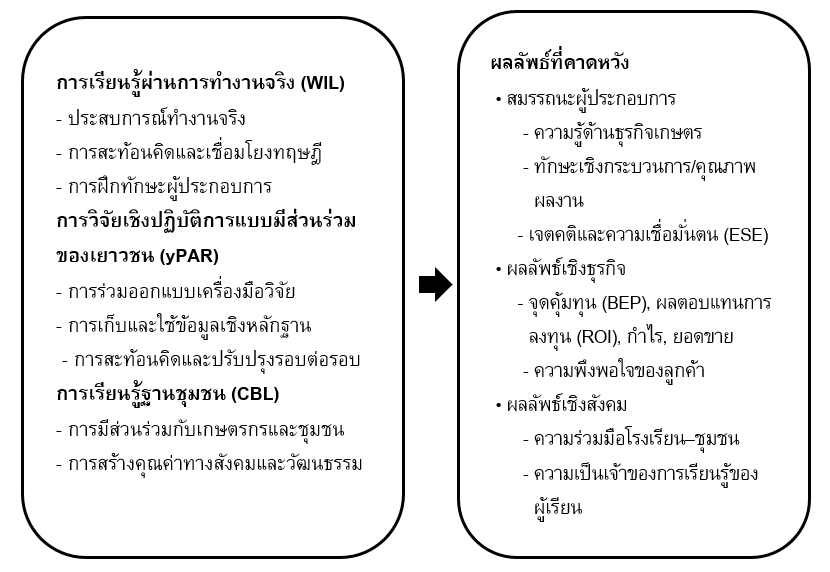
งานวิจัยนี้มีวัตถุประสงค์เพื่อพัฒนาและประเมินหน่วยการเรียนรู้แบบบูรณาการการทำงานกับการเรียนรู้ (WIL) ร่วมกับการวิจัยเชิงปฏิบัติการแบบมีส่วนร่วมของเยาวชน (yPAR) ในบริบท
การเรียนรู้ฐานชุมชน (CBL) โดยมีกลุ่มตัวอย่างเป็นนักเรียนระดับมัธยมศึกษาตอนต้น (ม.1-3)
โรงเรียนเทศบาลบ้านแฮด จำนวน 25 คน ซึ่งได้มาจากการเลือกแบบเจาะจง และมีผู้ให้ข้อมูลสมทบเป็นปราชญ์ชาวบ้านและคนในชุมชน จำนวน 12 คน ดำเนินกิจกรรมครอบคลุมกระบวนการปลูก-แปรรูป-จำหน่ายข้าวเหนียวดำ ใช้ระเบียบวิธีวิจัยแบบผสมผสาน (Mixed Methods) เครื่องมือที่ใช้ในการวิจัย ได้แก่ 1) แผนการจัดการเรียนรู้ 2) แบบทดสอบความรู้ธุรกิจเกษตร 3) แบบวัดความเชื่อมั่นและเจตคติผู้ประกอบการ 4) แบบประเมินสมรรถนะเชิงปฏิบัติ (Performance Assessment Form) ชนิดรูบริกแบบแยกองค์ประกอบ (Analytic Rubric) และ 5) แบบสอบถามความพึงพอใจลูกค้า สถิติที่ใช้ในการวิเคราะห์ข้อมูล ได้แก่ ค่าเฉลี่ย ส่วนเบี่ยงเบนมาตรฐาน การทดสอบที (t-test for dependent samples) และการวิเคราะห์เนื้อหา (Content Analysis) ผลการวิจัยพบว่า 1) นักเรียนมีคะแนนความรู้ธุรกิจเกษตร ความเชื่อมั่นตนเอง และเจตคติผู้ประกอบการหลังเรียนสูงกว่าก่อนเรียนอย่างมีนัยสำคัญทางสถิติ (p<.001) 2) ผลการประเมินสมรรถนะการปฏิบัติงานผ่านเกณฑ์ในระดับดีมาก
3) ด้านผลลัพธ์เชิงธุรกิจ โครงการประสบความสำเร็จโดยมีผลตอบแทนการลงทุน (ROI) ร้อยละ 15.8 และความพึงพอใจลูกค้าอยู่ในระดับมาก (Mean = 4.34) 4) ผลการวิเคราะห์เชิงคุณภาพพบลักษณะสำคัญ 3 ประเด็น ได้แก่ ความเป็นเจ้าของการเรียนรู้, การบูรณาการความรู้ข้ามวิชาในบริบทจริงและความร่วมมือระหว่างโรงเรียน-ชุมชนที่สร้างคุณค่าทางสังคม ข้อค้นพบนี้สอดคล้องกับกรอบการเรียนรู้เชิงประสบการณ์ และสามารถใช้เป็นแนวทางในการพัฒนาสมรรถนะผู้เรียนในบริบทชุมชนได้
Downloads
เอกสารอ้างอิง
He, J., & Giusti, M. M. (2010). Anthocyanins: Natural colorants with health-promoting properties. Annual Review of Food Science and Technology, 1(1), 163–187. https://doi.org/10.1146/annurev.food.080708.100754
Sompong, R., Siebenhandl-Ehn, S., Linsberger-Martin, G., & Berghofer, E. (2011). Physicochemical and antioxidative properties of Thai pigmented rice varieties. Food Chemistry, 124(1), 132–140.
https://doi.org/10.1016/j.foodchem.2010.05.115
Yodmanee, S., Karrila, T. T., & Pakdeechanuan, P. (2011). Physical, chemical and antioxidant properties of black glutinous rice. International Food Research Journal, 18(2), 421–431.
Shao, Y., & Bao, J. (2015). Polyphenols in whole rice and their health effects. Food Chemistry, 172, 40–49. https://doi.org/10.1016/j.foodchem.2014.08.116
Kolb, D. A. (1984). Experiential learning: Experience as the source of learning and development. Prentice-Hall.
Patrick, C.-J., Peach, D., Pocknee, C., Webb, F., Fletcher, M., & Pretto, G. (2008). The WIL report: A national scoping study. Queensland University of Technology. https://eprints.qut.edu.au/
Smith, C., Ferns, S., & Russell, L. (2014). Assessing the impact of WIL on student work-readiness. Asia-Pacific Journal of Cooperative Education, 15(4), 291–300.
Jackson, D. (2015). Employability skill development in work-integrated learning: Barriers and best practice. Asia-Pacific Journal of Cooperative Education, 16(3), 209–223.
Cammarota, J., & Fine, M. (2008). Revolutionizing education: Youth participatory action research in motion. Routledge.
Ozer, E. J. (2017). Youth-led participatory action research: Overview and potential for youth and community development. Adolescent Research Review, 2, 1–15 https://doi.org/10.1007/s40894-017-0057-2
Chen, C. C., Greene, P. G., & Crick, A. (1998). Does entrepreneurial self-efficacy distinguish entrepreneurs from managers?. Journal of Business Venturing, 13(4), 295–316.
Ajzen, I. (1991). The theory of planned behavior. Organizational Behavior and Human Decision Processes, 50(2), 179–211.
Bacigalupo, M., Kampylis, P., Punie, Y., & Van den Brande, G. (2016). EntreComp: The entrepreneurship competence framework. Publications Office of the European Union. https://data.europa.eu/doi/10.2791/593884
Bringle, R. G., & Hatcher, J. A. (1996). Implementing service-learning in higher education. Journal of Higher Education, 67(2), 221–239.
Nonedang, J & Techaatik, S. (2019). Implementation and Problems of Organic Brown Rice Group, Tum bon Nong Saeng, Ban Haet District, Khon Kaen Province. The 20th National Graduate Research Conference. March 15, 2019 at Khon Kaen University.
Hattie, J., & Timperley, H. (2007). The power of feedback. Review of Educational Research, 77(1), 81–112. https://doi.org/10.3102/003465430298487
Siemens, G., & Long, P. (2011). Penetrating the fog: Analytics in learning and education. EDUCAUSE Review, 46(1), 30–40. https://er.educause.edu/articles/2011/9/penetrating-the-fog-analytics-in-learning-and-education
ดาวน์โหลด
เผยแพร่แล้ว
รูปแบบการอ้างอิง
ฉบับ
ประเภทบทความ
สัญญาอนุญาต
ลิขสิทธิ์ (c) 2025 วารสารวิจัยและนวัตกรรมทางการศึกษาอุตสาหกรรม

อนุญาตภายใต้เงื่อนไข Creative Commons Attribution-NonCommercial-NoDerivatives 4.0 International License.
บทความนี้ได้รับการเผยแพร่ภายใต้สัญญาอนุญาต Creative Commons Attribution-NonCommercial-NoDerivatives 4.0 International (CC BY-NC-ND 4.0) ซึ่งอนุญาตให้ผู้อื่นสามารถแชร์บทความได้โดยให้เครดิตผู้เขียนและห้ามนำไปใช้เพื่อการค้าหรือดัดแปลง หากต้องการใช้งานซ้ำในลักษณะอื่น ๆ หรือการเผยแพร่ซ้ำ จำเป็นต้องได้รับอนุญาตจากวารสาร