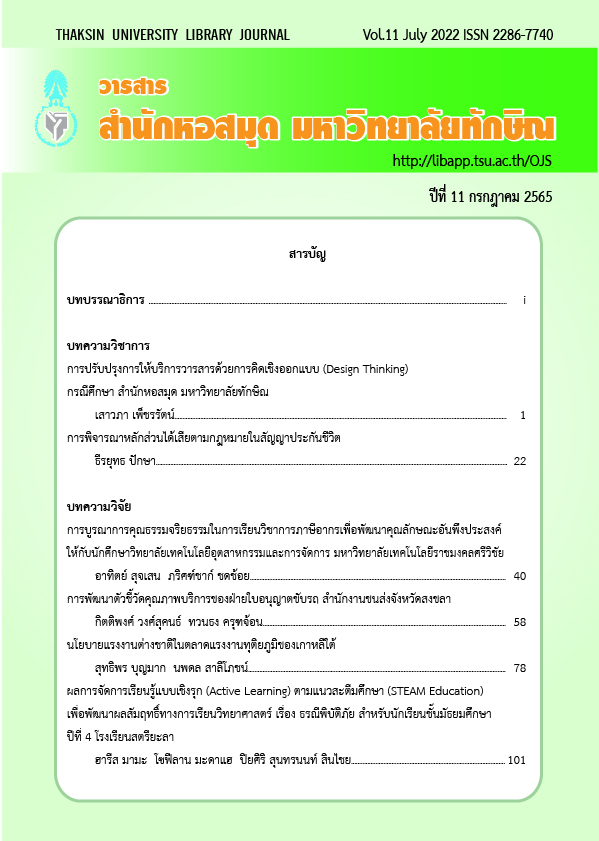
The effect of active learning on STEAM Education to developing science achievement on the disaster for 10th grade student of The Stree Yala School
Keywords:
STEAM Education, Active Learning, Activity Series, Science AchievementAbstract
Nowaday STEAM Education approach has been widely used in scientific learning management to develop thinking process, problem solving skills, analytical thinking, and creativity for learners.According to learning in the 21st century, it will focus on “child center” learning process, which encourage student’s self-Instructor and related to real life. The researcher, therefore, interested in applying active learning management along on STEAM Education in Earth, Astronomy and space 1 courses about disaster. The objective was to find efficiency value based on the standardized criterial of E1/E2=80/80, to compare scientific achievement before and after learned, and to study the students’ satisfaction after obtaining active learning on STEAM Education about disaster. The sample used this research were 35 students in grade 10th of Stree Yala School, Yala Province in the 1st semester of academic year 2020, using purposive sampling method. The instruments for data collection consisted of Lesson plan, active learning activity series, science achievement test, and satisfaction assessment form. The research results were that active learning activity series value based on the standardized criteria of 87.89/ 80.83, student who learning by using active learning on STEAM Education had before and after learned percentage average were 51.78 and 80.82 respectively, statically significant at .05, and the satisfaction of the students was 4.72, which was the highest level.
References
จารีพร ผลมูล, สุนีย์ เหมะประสิทธิ์, และเกริก ศักดิ์สุภาพ. (2558). การพัฒนาหน่วยการเรียนรู้บูรณาการแบบSTEAM สำหรับนักเรียนชั้นมัธยมศึกษาปีที่ 3 : กรณีศึกษา ชุมชนวังตะกอ จังหวัดชุมพร. วารสารวิจัย มข. มส. (บศ.), 3(2), 1-13.
ณัฐดนัย เนียมทอง. (2561). จาก STEM สู่ STEAM. สืบค้น 9 มิถุนายน 2565, จาก Scimath.org/article-stem/item/7812-stem-steam
ภิญโญ วงษ์ทอง. (2562). ผลของการจัดกิจกรรมการเรียนรู้บูรณาการ STEAM Education ที่มีต่อผลสัมฤทธิ์ทางการเรียนวิทยาศาสตร์ ทักษะการคิดอย่างมีวิจารณญาณ และความพึงพอใจของนักเรียนชั้นประถมศึกษาปีที่ 4. วารสารหน่วยวิจัยวิทยาศาสตร์ เทคโนโลยี และสิ่งแวดล้อมเพื่อการเรียนรู้, 10(1), 94-112.
วิจารณ์ พานิช. (2556). ส่งความสุขสู่คุณภาพการศึกษา. กรุงเทพฯ: มูลนิธิสถาบันส่งเสริมการจัดการความรู้เพื่อสังคม สถาบันเทคโนโลยีพระจอมเกล้าเจ้าคุณทหารลาดกระบัง.
สุภาพร พรไตร, และชนันธร อุดมศิลป์. (2561). การพัฒนาผลสัมฤทธิ์ทางการเรียน เรื่อง การแบงเซลล์แบบไมโอซิสด้วยกิจกรรมการลงมือปฏิบัติบนฐานการสืบเสาะวิทยาศาสตร์. วารสารหน่วยวิจัยวิทยาศาสตร์ เทคโนโลยี และ สิ่งแวดล้อมเพื่อการเรียนรู้, 9(2), 153-168.