Waste Management Behavior under Circular Economy Principles: A Comparison between Khao Sam Sip and Nong Wa Subdistricts, Khao Chakan District, Sa Kaeo Province
Keywords:
Circular Economy , Waste Management Behavior, Waste Collection Services , 5Rs, Public InfrastructureAbstract
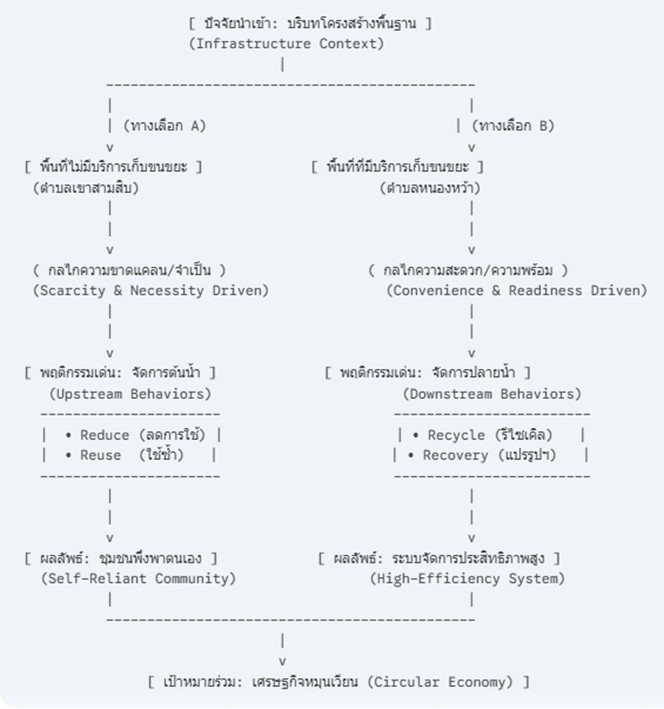
This research article aimed to: (1) examine waste management behaviors based on Circular Economy principles (5Rs); (2) compare waste management behaviors among residents in areas with and without waste collection services; and (3) propose sustainable waste management guidelines consistent with the context of public service readiness in Khao Chakan District, Sa Kaeo Province. Nong Wa Subdistrict was used as the area with waste collection services, while Khao Sam Sip Subdistrict represented the area without such services. A quantitative research approach was employed in this study. The sample consisted of 400 residents selected through simple random sampling. The research instrument was a questionnaire with an Index of Item-Objective Congruence (IOC) of 0.96. Data were analyzed using descriptive statistics, including frequency, percentage, mean, and standard deviation, as well as inferential statistics using the t-test. The findings revealed that: (1) the overall waste management behavior based on Circular Economy principles (5Rs) was at a high level across all dimensions (M = 3.86, SD = 0.611); and (2) there was a statistically significant difference in waste management behaviors between the two areas (p < .05), indicating that the type of public service provision influenced residents’ behaviors. Specifically, residents in the area without waste collection services (Khao Sam Sip Subdistrict) demonstrated higher levels of reduce and reuse behaviors, due to the necessity of minimizing waste generation to reduce the burden of self-disposal. In contrast, residents in the area with waste collection services (Nong Wa Subdistrict) showed stronger recycling and recovery behaviors, due to greater convenience and the availability of supporting systems. Furthermore, in areas without waste collection services, self-reliant household-level waste management models should be promoted. In areas with established services, emphasis should be placed on waste separation practices to support recycling and value-added waste processing.
References
กรมควบคุมมลพิษ. (2566). แผนปฏิบัติการด้านการจัดการขยะพลาสติก ระยะที่ 2 (พ.ศ. 2566 - 2570). กระทรวงทรัพยากรธรรมชาติและสิ่งแวดล้อม.
กรมควบคุมมลพิษ. (2567). รายงานสถานการณ์สถานที่กำจัดขยะมูลฝอยชุมชนของประเทศไทย ปี พ.ศ. 2566. กระทรวงทรัพยากรธรรมชาติและสิ่งแวดล้อม.
กรมส่งเสริมคุณภาพสิ่งแวดล้อม. (2563). คู่มือชุมชนปลอดขยะ (Zero Waste) ฉบับปรับปรุง. กระทรวงทรัพยากรธรรมชาติและสิ่งแวดล้อม.
กองสาธารณสุขและสิ่งแวดล้อม เทศบาลเมืองวังน้ำเย็น. (2563). รายงานการศึกษาปริมาณขยะในเขตเทศบาลเมืองวังน้ำเย็น ประจำปีงบประมาณ 2563. https://wangnamyencity.go.th/public/list/data/detail/id/1863/menu/1538/page/22
สำนักทะเบียนอำเภอเขาฉกรรจ์ จังหวัดสระแก้ว. (2565). ข้อมูลทั่วไป อำเภอเขาฉกรรจ์ จังหวัดสระแก้ว.
Bejranonda, S. & Lim, A. (2025). Factors Influencing Solid Waste Segregation Behavior of People in Bangkok. Journal of Applied Economics and Management Strategy, 12(1), 205–223. https://doi.org/10.56825/jaems.2025.1216240
Nițu, R.-M. (2024). The economic efficiency of waste management policies. Theoretical and Applied Economics, 1(638), 169–178. https://store.ectap.ro/articole/1729.pdf
Stoeva, K. & Alriksson, S. (2017). Influence of recycling programmes on waste separation behavior. Waste Management, 68, 732–741. https://doi.org/10.1016/j.wasman.2017.06.005
UNEP. (2024). Global Waste Management Outlook 2024: Beyond an Age of Waste. United Nations Environment Programme.
World Bank. (2018). What a Waste 2.0: A Global Snapshot of Solid Waste Management to 2050. World Bank.
Yukalang, N., Clarke, B., & Ross, K. (2017). Barriers to Effective Municipal Solid Waste Management in a Rapidly Urbanizing Area in Thailand. International Journal of Environmental Research and Public Health, 14(9), 1013. https://doi.org/10.3390/ijerph14091013
Downloads
Published
How to Cite
Issue
Section
License
Copyright (c) 2026 Journal of Interdisciplinary Review

This work is licensed under a Creative Commons Attribution-NonCommercial-NoDerivatives 4.0 International License.
1. เนื้อหาและข้อมูลในบทความที่ลงพิมพ์กับวารสารรัฐประศาสนศาสตร์และสหวิทยาเพื่อสังคม (Journal of Public Administration and Interdisciplinary Studies for Society) ถือเป็นข้อคิดเห็น และความรับผิดชอบของผู้เขียนบทความโดยตรงซึ่งกองบรรณาธิการวารสารไม่จำเป็นต้องเห็นด้วย หรือร่วมรับผิดชอบใด ๆ
2. บทความ ข้อมูล เนื้อหา รูปภาพ ฯลฯ ที่ได้รับการตีพิมพ์ในวารสารรัฐประศาสนศาสตร์และสหวิทยาเพื่อสังคม (Journal of Public Administration and Interdisciplinary Studies for Society) ถือเป็นลิขสิทธิ์ของวารสารรัฐประศาสนศาสตร์และสหวิทยาเพื่อสังคม (Journal of Public Administration and Interdisciplinary Studies for Society) หากบุคคลหรือหน่วยงานใดต้องการนำทั้งหมดหรือส่วนหนึ่ง ส่วนใดไปเผยแพร่ต่อหรือเพื่อการกระทำการใด ๆ จะต้องได้รับอนุญาตเป็นลายลักษณ์อักษรจากวารสารรัฐประศาสนศาสตร์และสหวิทยาเพื่อสังคม (Journal of Public Administration and Interdisciplinary Studies for Society) ก่อนเท่านั้น