The Development of Diagnostic Assessment for 21st Century Competencies
Keywords:
Diagnostic Assessment Instruments , Competency Assessment, Cognitive Diagnostic ModelsAbstract
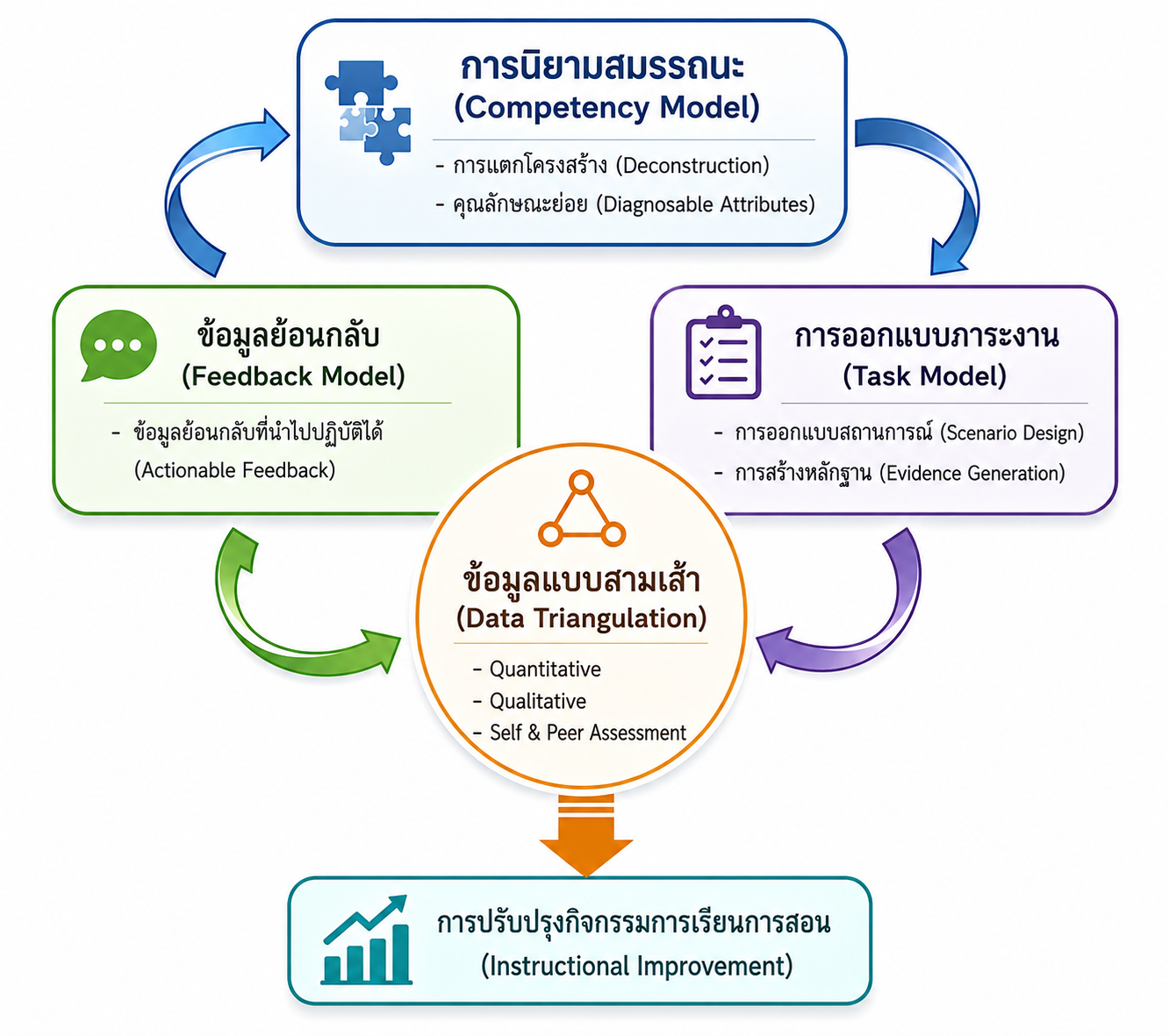
This academic article presents a conceptual framework for developing diagnostic competency assessments. It synthesizes international literature and relevant research and integrates the findings into the Thai educational context. The synthesis indicates that assessment in twenty-first-century education must move beyond measuring knowledge to assessing complex and abstract competencies. This requires breaking competencies down into subdimensions that allow for diagnostic analysis. Technology-supported performance assessments, such as simulations and behavioral log analysis, together with diagnostic classification models (DCMs), offer considerable potential for in-depth analysis. However, challenges concerning the validity of assessment interpretations can make the results complex and difficult for teachers to apply. These challenges are particularly relevant in Thailand, where technological readiness and understanding of advanced measurement theories vary across educational institutions. To address these issues, the article proposes a diagnostic cycle for improvement that emphasizes clear, actionable feedback. It also recommends data triangulation by combining quantitative assessment data with teachers’ qualitative observations. Practical guidelines tailored to the Thai context are proposed to help teachers design targeted learning activities, thereby bridging the gap between advanced measurement theory and classroom practice in Thailand.
References
กระทรวงศึกษาธิการ. (2560). หลักสูตรแกนกลางการศึกษาขั้นพื้นฐาน พุทธศักราช 2551 (ฉบับปรับปรุง พ.ศ. 2560). โรงพิมพ์ชุมนุมสหกรณ์การเกษตรแห่งประเทศไทย.
สถาบันทดสอบทางการศึกษาแห่งชาติ. (2562). รายงานผลการทดสอบ PISA-Based Test for Schools ของโรงเรียนไทย ปี 2562. สถาบันทดสอบทางการศึกษาแห่งชาติ (องค์การมหาชน).
สำนักงานเลขาธิการสภาการศึกษา. (2560). แผนการศึกษาแห่งชาติ พ.ศ. 2560-2579. กระทรวงศึกษาธิการ.
Black, P. & Wiliam, D. (1998). Assessment and classroom learning. Assessment in Education: Principles, Policy & Practice, 5(1), 7-74. http://dx.doi.org/10.1080/0969595980050102
Griffin, P. & Care, E. (Eds.). (2015). Assessment and teaching of 21st century skills: Methods and approach. Springer.
Hesse, F., Care, E., Buder, J., Sassenberg, K., & Griffin, P. (2015). A framework for teachable collaborative Problem-solving skills. In P. Griffin & E. Care (Eds.), Assessment and teaching of 21st century skills: Methods and approach. Springer.
Kane, M. T. (2006). Validation. In R. L. Brennan (Ed.), Educational measurement. Praeger.
Messick, S. (1989). Validity. In R. L. Linn (Ed.), Educational measurement. American Council on Education/Macmillan.
Mislevy, R. J., Steinberg, L. S. & Almond, R. G. (2003). On the structure of educational assessments. Measurement: Interdisciplinary Research and Perspectives, 1(1), 3–62.
OECD. (2018). Preparing our youth for an inclusive and sustainable world: The OECD PISA global competence framework. OECD Publishing.
Partnership for 21st Century Skills (P21). (2009). Framework for 21st century learning. Creative Education, 6(2). https://www.scirp.org/reference/referencespapers?referenceid=1412323
Glaser, R., Chudowsky, N. & Pellegrino, J.W. (Eds.). (2001) Knowing What Students Know. The Science and Design of Educational Assessment. National Academies Press.
Rupp, A. A., Templin, J., & Henson, R. A. (2010). Diagnostic measurement: Theory, methods, and applications. Guilford Press.
Downloads
Published
How to Cite
Issue
Section
License
Copyright (c) 2026 Journal of Interdisciplinary Review

This work is licensed under a Creative Commons Attribution-NonCommercial-NoDerivatives 4.0 International License.
1. เนื้อหาและข้อมูลในบทความที่ลงพิมพ์กับวารสารรัฐประศาสนศาสตร์และสหวิทยาเพื่อสังคม (Journal of Public Administration and Interdisciplinary Studies for Society) ถือเป็นข้อคิดเห็น และความรับผิดชอบของผู้เขียนบทความโดยตรงซึ่งกองบรรณาธิการวารสารไม่จำเป็นต้องเห็นด้วย หรือร่วมรับผิดชอบใด ๆ
2. บทความ ข้อมูล เนื้อหา รูปภาพ ฯลฯ ที่ได้รับการตีพิมพ์ในวารสารรัฐประศาสนศาสตร์และสหวิทยาเพื่อสังคม (Journal of Public Administration and Interdisciplinary Studies for Society) ถือเป็นลิขสิทธิ์ของวารสารรัฐประศาสนศาสตร์และสหวิทยาเพื่อสังคม (Journal of Public Administration and Interdisciplinary Studies for Society) หากบุคคลหรือหน่วยงานใดต้องการนำทั้งหมดหรือส่วนหนึ่ง ส่วนใดไปเผยแพร่ต่อหรือเพื่อการกระทำการใด ๆ จะต้องได้รับอนุญาตเป็นลายลักษณ์อักษรจากวารสารรัฐประศาสนศาสตร์และสหวิทยาเพื่อสังคม (Journal of Public Administration and Interdisciplinary Studies for Society) ก่อนเท่านั้น