Mathematical Beliefs of Learners: Measurement Approaches and Applications
Keywords:
Mathematical Beliefs , Learners, Measurement , ApplicationsAbstract
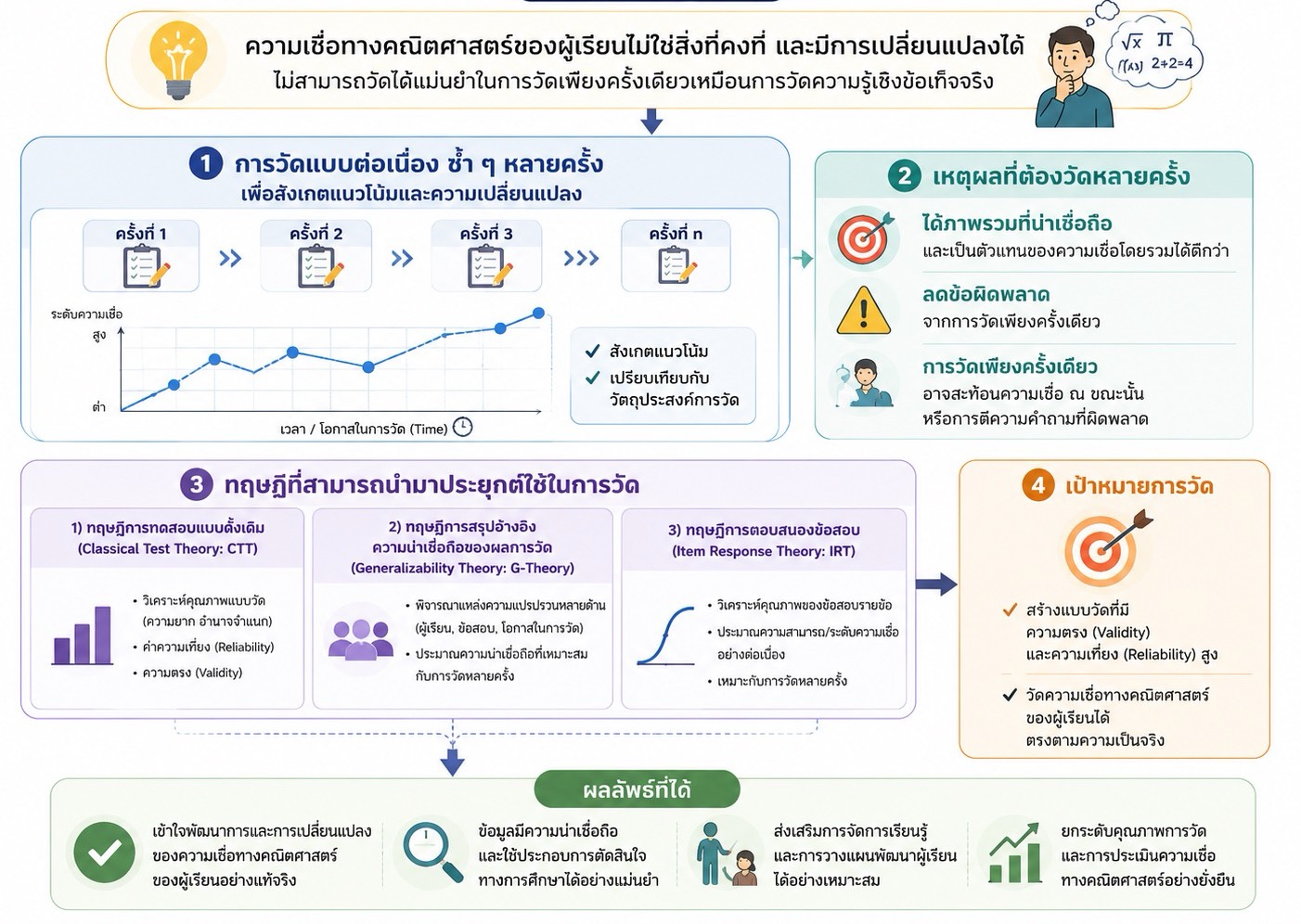
This academic article aimed to examine learners’ mathematical beliefs across various dimensions, as well as diverse and appropriate measurement approaches for use in academic research. Beliefs were regarded as abstract psychological factors that significantly influenced learning outcomes. A major challenge in measuring beliefs was the lack of comprehensive and reliable instruments, as self-report questionnaires could be subject to bias. Mathematical beliefs were defined as learners’ conceptual frameworks or personal perceptions regarding the nature of mathematics, the importance and value of the subject, their own mathematical abilities, the role of teachers, and effective methods of teaching and learning mathematics. To measure such beliefs, this article presented and integrated major measurement theories, including Classical Test Theory (CTT) for assessing validity and reliability, Generalizability Theory (G-Theory) for addressing sources of measurement variance, and Item Response Theory (IRT) for more accurately estimating item parameters and learners’ latent traits. The proposed measurement approaches consisted of: (1) quantitative methods, such as rating scales and Computerized Adaptive Testing (CAT); (2) qualitative methods, such as interviews and reflective records; and (3) mixed-method approaches. The findings indicated that mathematical beliefs were not fixed and could change over time. Therefore, an appropriate and accurate measurement approach was repeated continuous assessment in order to observe trends and reduce errors resulting from one-time measurement. A comprehensive understanding and assessment of mathematical beliefs could serve as an important guideline for developing educational innovations that promote learners’ growth in mathematics.
References
กฤตเมธ กสิณศิลป์ และยุทธพงศ์ พิศิษฐ์ชาติ. (2568). การศึกษาความเข้าใจทางคณิตศาสตร์และความเชื่อมั่นในตนเองที่มีผลต่อการแก้ปัญหาทางคณิตศาสตร์ของนักเรียนชั้นมัธยมศึกษาปีที่ 1. วารสารมณีเชษฐาราม, 8(5), 650-664.
เนตรดาว ปทุมพร และนวพล นนทภา. (2563). การศึกษาความเชื่อของครูเกี่ยวกับการจัดการเรียนรู้ที่ส่งผลต่อเจตคติต่อคณิตศาสตร์ของนักเรียนชั้นมัธยมศึกษาตอนต้น. วารสารมหาวิทยาลัยราชภัฏมหาสารคาม, 14(3), 151-164.
ปิยาภัสร์ แสนเสนา และยุทธพงศ์ ทิพย์ชาติ. (2567). การศึกษาความเชื่อทางคณิตศาสตร์กับการให้เหตุผลทางคณิตศาสตร์ของนักเรียนชั้นมัธยมศึกษาปีที่ 1. Journal for Developing the Social and Community, 11(2), 69-84.
วันทนา จูมจัน และชาญณรงค์ เฮียงราช. (2551). การศึกษาอิทธิพลของความเชื่อทางคณิตศาสตร์ชั้นมัธยมศึกษาปีที่ 1 โรงเรียนน้ำพองศึกษา ที่มีต่อความสามารถในการแก้ปัญหาทางคณิตศาสตร์. วารสารศึกษาศาสตร์ มหาวิทยาลัยขอนแก่น, 31(4), 87-94.
ศิริชัย กาญจนวาสี. (2563). ทฤษฎีการทดสอบแนวใหม่. สำนักพิมพ์จุฬาลงกรณ์มหาวิทยาลัย.
สุพรต บุญอ่อน และธีรพันธ์ เชิญรัมย์. (2567). ความเชื่อในสังคมไทย. วารสารบัณฑิตศึกษาปริทรรศน์ วิทยาลัยสงฆ์นครสวรรค์, 12(3), 109-119.
สุพรพันธ์ จิตบรรเทา. (2553). การศึกษาความเชื่อ (Belief) ในการเรียนภาษาญี่ปุ่นของนักเรียนระดับมัธยมศึกษาตอนปลายชาวไทย กรณีศึกษาโรงเรียนมัธยมศึกษาในเขตกรุงเทพมหานคร. เจแปนฟาวน์เดชั่น https://ba.jpf.go.jp/wp-content/uploads /2025/08/03SUPORNPAN.pdf
อนุรักษ์ นิลหุต, กนิษฐ์ ศรีเคลือบ และสุวิมล ว่องวาณิช. (2566). การพัฒนาแบบวัดความเชื่อด้านความรู้ทางวิทยาศาสตร์ของนิสิตนักศึกษาครู. ศึกษาศาสตร์สาร มหาวิทยาลัยเชียงใหม่, 7(1), 1-15.
Bandura, A. (1997). Self-efficacy: The exercise of control. W.H. Freeman.
Barcelos, A. M. F. (2003). Teachers’ and students’ beliefs within a Deweyan framework: Conflict and influence. In P. Kalaja & A. M. F. Barcelos (Eds.), Beliefs about SLA: New research approaches, 171-199. Kluwer Academic Publishers. https://link.springer.com/chapter/10.1007/978-1-4020-4751-0_8
Boaler, J. (2016). Mathematical mindsets: Unleashing students' potential through creative math, inspiring messages and innovative teaching. Jossey-Bass/Wiley.
Buehl, M. M. & Beck, J. S. (2015). The Relationship between Teachers’ Beliefs and Teachers’ Practices. In H. Fives, & M.G. Gill (Eds.), International Handbook of Research on Teachers’ Beliefs (pp. 66-84). Taylor & Francis.
Cotterall, S. (1995) Readiness for Autonomy: Investigating Learner Beliefs. System, 23(2), 195-205. https://doi.org/10.1016/0346-251X(95)00008-8
Dweck, C. S. (1986). Motivational Processes Affecting Learning. American Psychologist, 41(10), 1040-1048. http://dx.doi.org/10.1037/0003-066X.41.10.1040
Lazim, M. A., Abu Osman M. T. & Wan, Salihin W. A. (2004). The Statistical Evidence in Describing the Students’ Beliefs about Mathematics. International Journal for Mathematics Teaching and Learning, 6(1), 1-12. https://www. cimt.org.uk/journal/
McLeod, D. B. (1992). Research on effect in mathematics education: A reconceptualization. In D. A. Grouws (Ed.), Handbook of research on mathematics teaching and learning. MacMillan. https://psycnet.apa.org/ record/1992-97586-023
Ozturk, T. & Guven B. (2016). Evaluating Students’ Beliefs in Problem Solving Process: A Case Study. Karadeniz Technical University, TURKEY. Eurasia Journal of Mathematics, Science & Technology Education, 12(2), 411-429.
Prochaska, J. O. & DiClemente, C. C. (1982). Transtheoretical therapy: Toward a more integrative model of change. Psychotherapy: Theory, Research & Practice, 19(3), 276–288. https://doi.org/10.1037/h0088437
Schoenfeld, A. H. (1985). Mathematical Problem Solving. Academic Press.
Schoenfeld, A. H. (1992). Learning to think mathematically: Problem solving, metacognition, and sense making in mathematics. In D. A. Grows (Ed.), Handbook of research on mathematics teaching and learning. Macmillan.
Schwitzgebel, E. (2023). Belief. In E. N. Zalta & U. Nodelman (Eds.), The Stanford Encyclopedia of Philosophy (Winter 2023 edition). Metaphysics Research Lab, Stanford University. https://plato.stanford.edu/entries/belief/
Tahir, I. M. & Bakar, N. M. A. (2009). Influence of demographic factors on students’ beliefs in learning mathematics. International Education Studies, 2(3), 120-126.
Downloads
Published
How to Cite
Issue
Section
License
Copyright (c) 2026 Journal of Interdisciplinary Review

This work is licensed under a Creative Commons Attribution-NonCommercial-NoDerivatives 4.0 International License.
1. เนื้อหาและข้อมูลในบทความที่ลงพิมพ์กับวารสารรัฐประศาสนศาสตร์และสหวิทยาเพื่อสังคม (Journal of Public Administration and Interdisciplinary Studies for Society) ถือเป็นข้อคิดเห็น และความรับผิดชอบของผู้เขียนบทความโดยตรงซึ่งกองบรรณาธิการวารสารไม่จำเป็นต้องเห็นด้วย หรือร่วมรับผิดชอบใด ๆ
2. บทความ ข้อมูล เนื้อหา รูปภาพ ฯลฯ ที่ได้รับการตีพิมพ์ในวารสารรัฐประศาสนศาสตร์และสหวิทยาเพื่อสังคม (Journal of Public Administration and Interdisciplinary Studies for Society) ถือเป็นลิขสิทธิ์ของวารสารรัฐประศาสนศาสตร์และสหวิทยาเพื่อสังคม (Journal of Public Administration and Interdisciplinary Studies for Society) หากบุคคลหรือหน่วยงานใดต้องการนำทั้งหมดหรือส่วนหนึ่ง ส่วนใดไปเผยแพร่ต่อหรือเพื่อการกระทำการใด ๆ จะต้องได้รับอนุญาตเป็นลายลักษณ์อักษรจากวารสารรัฐประศาสนศาสตร์และสหวิทยาเพื่อสังคม (Journal of Public Administration and Interdisciplinary Studies for Society) ก่อนเท่านั้น