Modern Organizational Management through Lean Concepts: Lessons and Recommendations for the Thai Public Sector
Keywords:
Modern Organizational Management , Lean Concepts, Lessons and Recommendations , Thai Public SectorAbstract
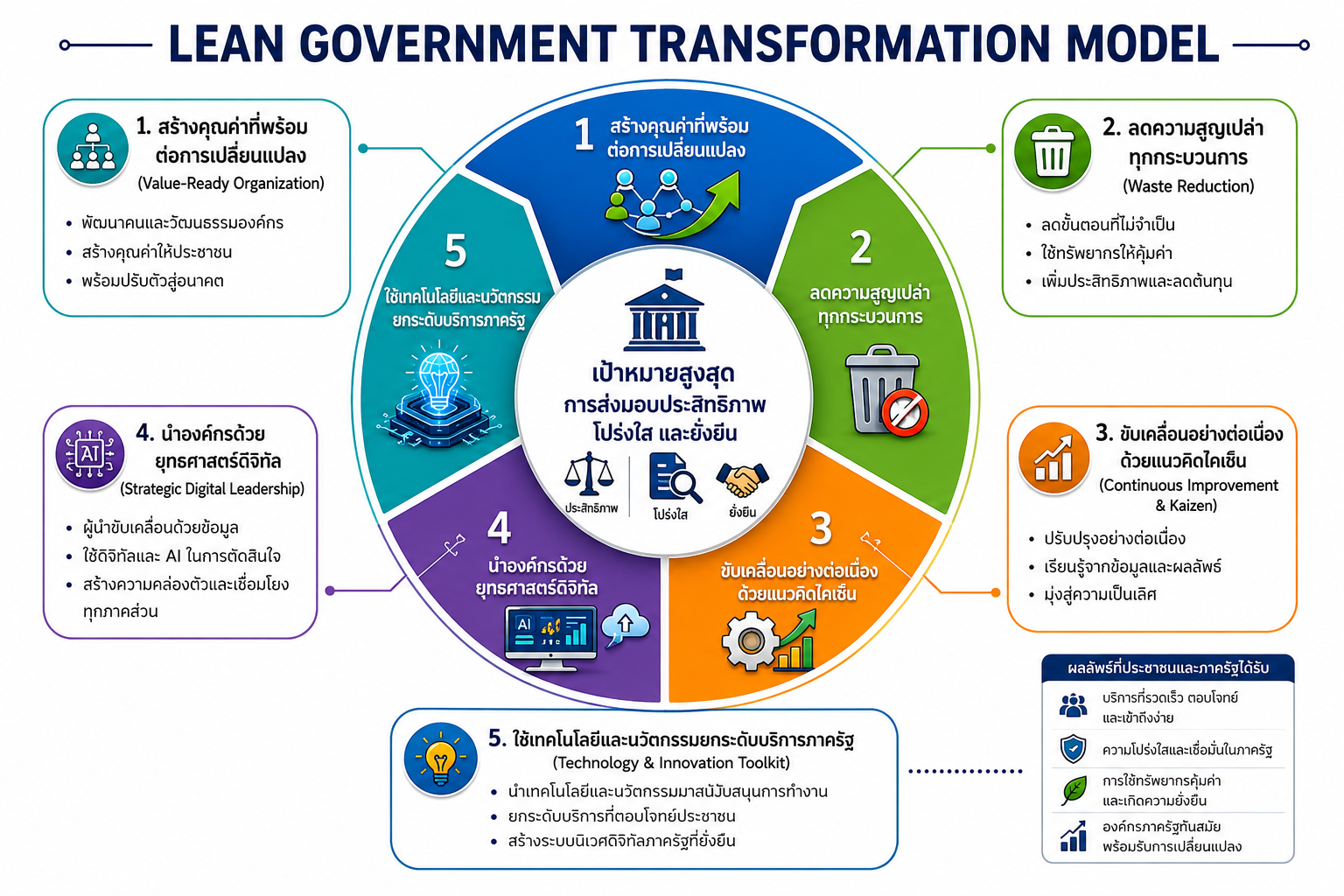
This article aimed to present findings and recommendations derived from Lean principles and case studies conducted in Thailand during 2019–2025 for the development of the Thai public sector. The synthesis of case studies revealed that the implementation of Lean concepts could effectively reduce costs, shorten operational time, and improve service quality. For example, in research institutes, expenses were reduced by 89.13%, lead time was reduced by 65.77%, and process cycle time was reduced by 54.03%. In food-processing SMEs, transportation costs were reduced by 245,568 baht and carbon dioxide (CO₂) emissions were reduced by 2,931 kilograms. In educational institutions, Lean implementation reduced operational procedures, increased the speed of document accessibility, and improved user satisfaction by 56%. These findings reflected the potential of Lean concepts to strengthen economic, social, and environmental dimensions. Based on the study, the author developed the “Lean Government Transformation Model,” which consisted of six key components divided into two dimensions. The first dimension, fundamental Lean principles, included: (1) value creation for citizens, (2) waste reduction, and (3) continuous improvement. The second dimension, dynamic components aligned with the context of the Thai public sector, included: (4) building change-ready organizations, (5) the utilization of technology and innovation, and (6) strategic and digital leadership. The model aimed to enable Thai government agencies to design citizen-centered systems that were transparent and prepared to cope with future challenges.
References
ชื่นนภา บุตดีวงค์ และกิตติยาภรณ์ บรรไพ. (2566). การบริหารองค์การด้วยเทคนิคสมัยใหม่. วารสารการบริหาร การจัดการ และการพัฒนาที่ยั่งยืน, 1(1), 69–83.
ดามธรรม จินากูล. (2562). การพัฒนาสำนักงานลีน. (รายงานการวิจัย). มหาวิทยาลัยเทคโนโลยีสุรนารี.
ตุลาพล นิติเดชา. (2564). การประยุกต์ใช้แนวคิดลีนเพื่อเพิ่มประสิทธิภาพงานสนับสนุนวิชาการในสถาบันการศึกษา: กรณีศึกษาคณะโลจิสติกส์ มหาวิทยาลัยบูรพา. (รายงานการวิจัย). คณะโลจิสติกส์ มหาวิทยาลัยบูรพา.
ปรินทร ศิริเอี้ยวพิกูล. (2568). การบริหารโครงการก่อสร้างด้วยแนวคิด Lean Construction: กรณีศึกษาความสำเร็จและบทเรียนในประเทศไทย. วารสารสหวิทยาการสังคมศาสตร์และการศึกษา, 1(3), 57–70.
สุวัฒน์ จรรยาพูน, สุรทิน ธัญญะผลิน. (2568). การตระหนักรู้ในการใช้เครื่องมือลีนในธุรกิจโลจิสติกส์ของประเทศไทย. วารสารวิชาการและวิจัยสังคมศาสตร์, 20(1), 193-208.
Bhatia, N. & Drew, J. (2006). Applying lean production to the public sector. The McKinsey Quarterly, 3(1), 97-98.
Bhuvanij, K., Praneetpolgrang, P., Sukvaree, T. & Saekhow, N. (2023). Strategic digital leadership in the public sector for digital transformation Towards Enabling Sustainable Digital Economy in Thailand. International Journal of Engineering Research and Technology, 12(8), 1-19.
Klein, L. L., Vieira, K. M., Marçal, E. F., Pereira, B. A. D. & Ercolani, L. D. (2022). The influence of lean management practices on process effectiveness: A quantitative study in a public institution. Sage Journals, 12(2). https://doi.org/10.1177/21582440221088837
Liker, J. K. (2004). The Toyota way: 14 management principles from the world's greatest manufacturer. McGraw-Hill.
OECD. (2022). Open and Connected Government Review of Thailand (EN). OECD Publishing. https://www.oecd.org/en/publications/oecd-skills-strategy-thailand_153a1fe6-en/
Ohno, T. (1988). Toyota Production System: Beyond large-scale production. Productivity Press.
Osborne, D. & Gaebler, T., Eds. (1992) Reinventing Government. How the Entrepreneurial Spirit Is Transforming the Public Sector. Penguin Books USA Inc.
Presciuttini, A. (2025). Integrating lean management and emerging technologies for enhanced sustainable performance. Data Science and Management. https://doi.org/10.1016/j.dsm.2025.08.004
Radnor, Z. & Osborne, S. P. (2013). Lean: A failed theory for public services?. Public Management Review, 15(2), 265–287. https://doi.org/10.1080/14719037.2012.748820
Ratthanakwan, S. & Choonhaklai, S. (2024). The public sector innovation for development of Thai public sector. Kasetsart Journal of Social Sciences, 45(1), 203–214. https://doi.org/10.34044/j.kjss.2024.45.1.21
Vorawitsurawathana, K. (2024). Lean management as a framework to implement sustainability for SMEs. [Unpublished Master’s Thesis]. Thammasat University.
Womack, J. P. & Jones, D. T. (1996). Lean thinking: Banish waste and create wealth in your corporation. Simon & Schuster.
Downloads
Published
How to Cite
Issue
Section
License
Copyright (c) 2026 Journal of Interdisciplinary Review

This work is licensed under a Creative Commons Attribution-NonCommercial-NoDerivatives 4.0 International License.
1. เนื้อหาและข้อมูลในบทความที่ลงพิมพ์กับวารสารรัฐประศาสนศาสตร์และสหวิทยาเพื่อสังคม (Journal of Public Administration and Interdisciplinary Studies for Society) ถือเป็นข้อคิดเห็น และความรับผิดชอบของผู้เขียนบทความโดยตรงซึ่งกองบรรณาธิการวารสารไม่จำเป็นต้องเห็นด้วย หรือร่วมรับผิดชอบใด ๆ
2. บทความ ข้อมูล เนื้อหา รูปภาพ ฯลฯ ที่ได้รับการตีพิมพ์ในวารสารรัฐประศาสนศาสตร์และสหวิทยาเพื่อสังคม (Journal of Public Administration and Interdisciplinary Studies for Society) ถือเป็นลิขสิทธิ์ของวารสารรัฐประศาสนศาสตร์และสหวิทยาเพื่อสังคม (Journal of Public Administration and Interdisciplinary Studies for Society) หากบุคคลหรือหน่วยงานใดต้องการนำทั้งหมดหรือส่วนหนึ่ง ส่วนใดไปเผยแพร่ต่อหรือเพื่อการกระทำการใด ๆ จะต้องได้รับอนุญาตเป็นลายลักษณ์อักษรจากวารสารรัฐประศาสนศาสตร์และสหวิทยาเพื่อสังคม (Journal of Public Administration and Interdisciplinary Studies for Society) ก่อนเท่านั้น