Assessment and Evaluation of Core Competencies in the Competency-Based Curriculum for Primary School Students
DOI:
https://doi.org/10.14456/jpais.2026.5Keywords:
Assessment and Evaluation , Core Competencies, Competency-Based Curriculum , Primary School StudentsAbstract
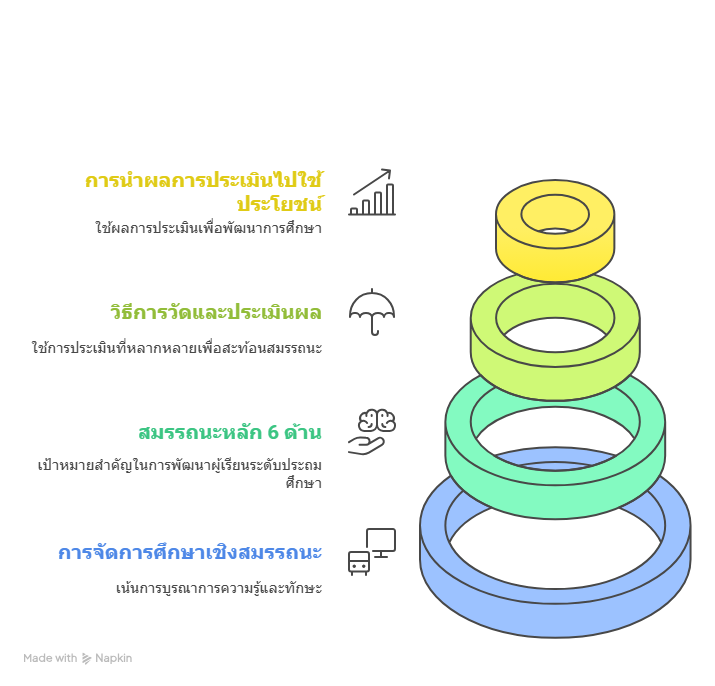
This academic article focused on examining the approaches to assessing and evaluating core competencies of primary school students, based on the competency-based curriculum framework. The framework specified six core competencies: self-management, higher-order thinking, communication, teamwork, responsible citizenship, and sustainable coexistence with nature and science. The assessment and evaluation of competencies were required to reflect students’ knowledge, skills, and attributes in an integrated manner, to capture the students’ true potential. The article analyzed appropriate approaches and methods, such as situational assessment, authentic task assessment, portfolios, observation, self-assessment, and performance-based assessment, to enable teachers and relevant stakeholders to use the evaluation results as feedback for improving teaching and learning. These methods also aimed to promote learning that addressed individual differences among students. In conclusion, the assessment and evaluation of core competencies not only served to verify learning outcomes but also functioned as a key mechanism for enhancing student quality and establishing a solid foundation for the reform of Thai education in the 21st century.
References
เยาวดี วิบูลย์ศรี. (2545). การวัดผลและการสร้างแบบสอบผลสัมฤทธิ์. สำนักพิมพ์แห่งจุฬาลงกรณ์มหาวิทยาลัย.
รัชนีวรรณ วนิชย์ถนอม. (2548). การปรับใช้สมรรถนะในการบริหารทรัพยากรมนุษย์. วารสารข้าราชการ, 50(2), 10-24.
วรรณ์ดี แสงประทีปทอง. (2556). การวัดและการประเมินผลการจัดการเรียนรู้, ประมวล สาระชุดวิชาการพัฒนาระบบการจัดการเรียนรู้ หน่วยที่ 10. มหาวิทยาลัยสุโขทัยธรรมาธิราช.
สมหวัง พิธิยานุวัฒน์. (2549). การวิจัยประเมินโครงการด้านการศึกษา. สํานักพิมพ์แห่งจุฬาลงกรณ์มหาวิทยาลัย.
สำนักงานคณะกรรมการการศึกษาขั้นพื้นฐาน. (2564). สมรรถนะหลัก 6 ประการ. Competency - based Education. https://cbethailand.com/หลักสูตร-2/กรอบหลักสูตร/สมรรถนะหลัก-6-ประการ.
Ebel, R. L. & Frisbie, D. A. (1986). Essentials of Educational Measurement. Prentice-Hall, Inc.
Furnham, A. 1990). The Protestant work ethic: The psychology of work-related beliefs and behaviours. Routledge.
Kierstead, J. (1998). Personality and job performance: The role of individual differences in predicting job performance. Public Service Commission of Canada.
McClelland, D. C. (1980). Human motivation. Scott, Foresman.
Scriven, M. S. (1967). The methodology of evaluation. In R. E. Stake (Ed.), Perspectives of curriculum evaluation. Rand McNally.
Smith, F. M. & Adams, S. (1965). A theory of appropriate statistics. Psychometrika, 30, 99-127.
Stufflebeam, D. L. & Shinkfield, A. J. (2007). Evaluation theory, models, & applications. John Wiley & Sons.
Downloads
Published
How to Cite
Issue
Section
License
Copyright (c) 2025 Journal of Interdisciplinary Review

This work is licensed under a Creative Commons Attribution-NonCommercial-NoDerivatives 4.0 International License.
1. เนื้อหาและข้อมูลในบทความที่ลงพิมพ์กับวารสารรัฐประศาสนศาสตร์และสหวิทยาเพื่อสังคม (Journal of Public Administration and Interdisciplinary Studies for Society) ถือเป็นข้อคิดเห็น และความรับผิดชอบของผู้เขียนบทความโดยตรงซึ่งกองบรรณาธิการวารสารไม่จำเป็นต้องเห็นด้วย หรือร่วมรับผิดชอบใด ๆ
2. บทความ ข้อมูล เนื้อหา รูปภาพ ฯลฯ ที่ได้รับการตีพิมพ์ในวารสารรัฐประศาสนศาสตร์และสหวิทยาเพื่อสังคม (Journal of Public Administration and Interdisciplinary Studies for Society) ถือเป็นลิขสิทธิ์ของวารสารรัฐประศาสนศาสตร์และสหวิทยาเพื่อสังคม (Journal of Public Administration and Interdisciplinary Studies for Society) หากบุคคลหรือหน่วยงานใดต้องการนำทั้งหมดหรือส่วนหนึ่ง ส่วนใดไปเผยแพร่ต่อหรือเพื่อการกระทำการใด ๆ จะต้องได้รับอนุญาตเป็นลายลักษณ์อักษรจากวารสารรัฐประศาสนศาสตร์และสหวิทยาเพื่อสังคม (Journal of Public Administration and Interdisciplinary Studies for Society) ก่อนเท่านั้น