The Role of Local Authorities in Preventing and Addressing Drug Problems in Maha Phot Subdistrict, Kao Liao District, Nakhon Sawan Province, according to the Four Right Efforts (Sammappadhana) Principles
DOI:
https://doi.org/10.14456/jpais.2025.2Keywords:
Role of Local Authorities, Addressing Drug Problems, Drug Prevention and Intervention, Four Right Efforts (Sammappadhana) PrinciplesAbstract
This research article aimed to: (1) examine the role of local administrators in preventing and solving drug problems in Maha Pho Subdistrict, Kao Liao District, Nakhon Sawan Province; (2) investigate the relationship between the Four Right Efforts (Sammappadhāna) and the roles of local administrators in drug prevention and problem-solving; and (3) propose guidelines for enhancing the roles of local administrators in addressing drug problems based on the principles of the Four Right Efforts. A mixed-methods research design was employed. The quantitative component involved a sample of 365 participants aged 18 years and above, selected using Taro Yamane’s formula from a total population of 4,110 residents in Maha Pho Subdistrict. Data were collected using a questionnaire with a reliability coefficient of .989. Statistical analyses included percentage, mean, standard deviation, and Pearson’s correlation coefficient. The qualitative component consisted of in-depth interviews with 21 key informants, selected purposively, and analyzed using descriptive content analysis. The findings revealed that: (1) the overall role of local administrators in drug prevention and problem-solving based on the Four Right Efforts was at a high level ( = 4.11, S.D. = 0.69), and according to Barlow’s role theory, the overall level was also high (
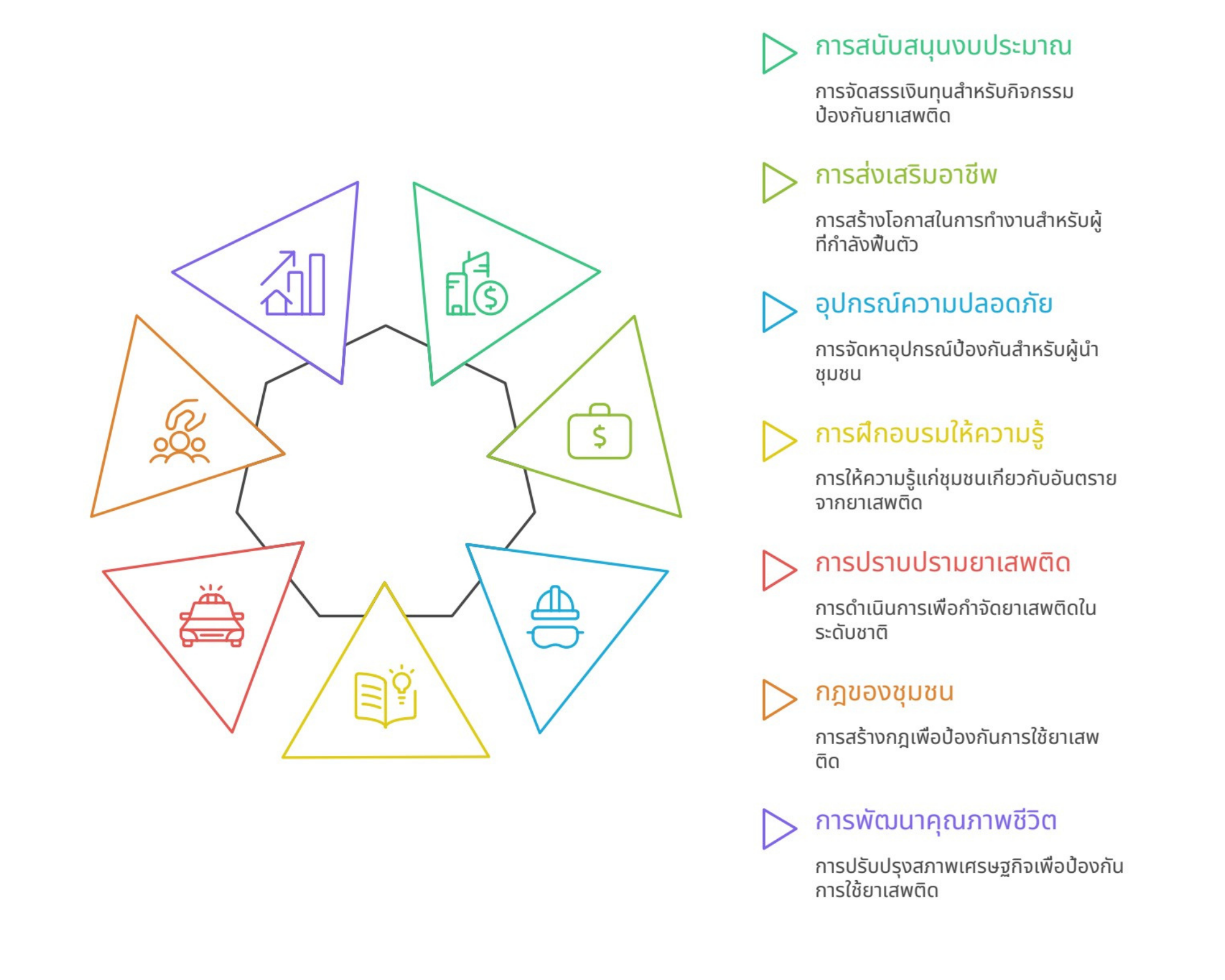
= 4.12, S.D. = 0.69); (2) there was a very high correlation between the Four Right Efforts and the roles of local administrators in preventing and solving drug problems, with a Pearson correlation coefficient of .903**; and (3) guidelines for enhancing the roles of local administrators include: (1) providing governmental budget support, (2) equipping local leaders with protective gear or tools to ensure their safety during operations, (3) implementing strict nationwide drug suppression policies to prevent the spread of drug problems into local communities, and (4) establishing community rules collectively for drug prevention and control. These findings provide practical insights for strengthening community-based drug prevention strategies aligned with Buddhist principles.
References
กรมราชทัณฑ์. (2567). รายงานสถิติผู้ต้องราชทัณฑ์ทั่วประเทศ. http://www.correct.go.th/ rt03pdf/report_result.php?date=2024-01-01&report=
ถิรวัฒน์ ณ ระนอง. (2558). บทบาทของผู้ใหญ่บ้านในการแก้ไข ปัญหายาเสพติด อำเภอเมือง จังหวัดปราจีนบุรี. [วิทยานิพนธ์ปริญญาโทไม่ได้ตีพิมพ์]. มหาวิทยาลัยบูรพา.
ไทยพีบีเอส. (2565). ชายแดนระอุ! ขบวนการค้ายาเสพติดมุ่งเป้าเข้าไทย กลับมาระบาดหนัก ผู้เสพขอเข้าบำบัดอื้อ. https://www.thaipbs.or.th/news/content/322768
ประมวลกฎหมายยาเสพติด พ.ศ. 2564. (2564, 8 พฤศจิกายน). ราชกิจจานุเบกษา. เล่มที่ 138 ตอนที่ 73 ก, หน้า 59.
สำนักงานคณะกรรมการป้องกันและปราบปรามยาเสพติด (ป.ป.ส.). (2567). แผนปฏิบัติการป้องกัน ปราบปราม และแก้ไขปัญหายาเสพติดปีงบประมาณ พ.ศ. 2568. กระทรวงยุติธรรม.
Berlo, D. K. (1966). The process of communication: An introduction to theory and practice. Holt, Rinehart and Winston.
Yamane, T. (1973). Statistics: An Introductory Analysis. Harper and Row Publications.
Downloads
Published
How to Cite
Issue
Section
License
Copyright (c) 2025 Journal of Interdisciplinary Review

This work is licensed under a Creative Commons Attribution-NonCommercial-NoDerivatives 4.0 International License.
1. เนื้อหาและข้อมูลในบทความที่ลงพิมพ์กับวารสารรัฐประศาสนศาสตร์และสหวิทยาเพื่อสังคม (Journal of Public Administration and Interdisciplinary Studies for Society) ถือเป็นข้อคิดเห็น และความรับผิดชอบของผู้เขียนบทความโดยตรงซึ่งกองบรรณาธิการวารสารไม่จำเป็นต้องเห็นด้วย หรือร่วมรับผิดชอบใด ๆ
2. บทความ ข้อมูล เนื้อหา รูปภาพ ฯลฯ ที่ได้รับการตีพิมพ์ในวารสารรัฐประศาสนศาสตร์และสหวิทยาเพื่อสังคม (Journal of Public Administration and Interdisciplinary Studies for Society) ถือเป็นลิขสิทธิ์ของวารสารรัฐประศาสนศาสตร์และสหวิทยาเพื่อสังคม (Journal of Public Administration and Interdisciplinary Studies for Society) หากบุคคลหรือหน่วยงานใดต้องการนำทั้งหมดหรือส่วนหนึ่ง ส่วนใดไปเผยแพร่ต่อหรือเพื่อการกระทำการใด ๆ จะต้องได้รับอนุญาตเป็นลายลักษณ์อักษรจากวารสารรัฐประศาสนศาสตร์และสหวิทยาเพื่อสังคม (Journal of Public Administration and Interdisciplinary Studies for Society) ก่อนเท่านั้น