Community Rights in Water Management for Agricultural Purposes around Bueng Krachang Ngam, Sala Daeng Subdistrict, Krok Phra District, Nakhon Sawan Province
DOI:
https://doi.org/10.14456/jpais.2025.6Keywords:
Community Rights , Water Management for Agricultural Purposes, Six Saraniyadhamma PrinciplesAbstract
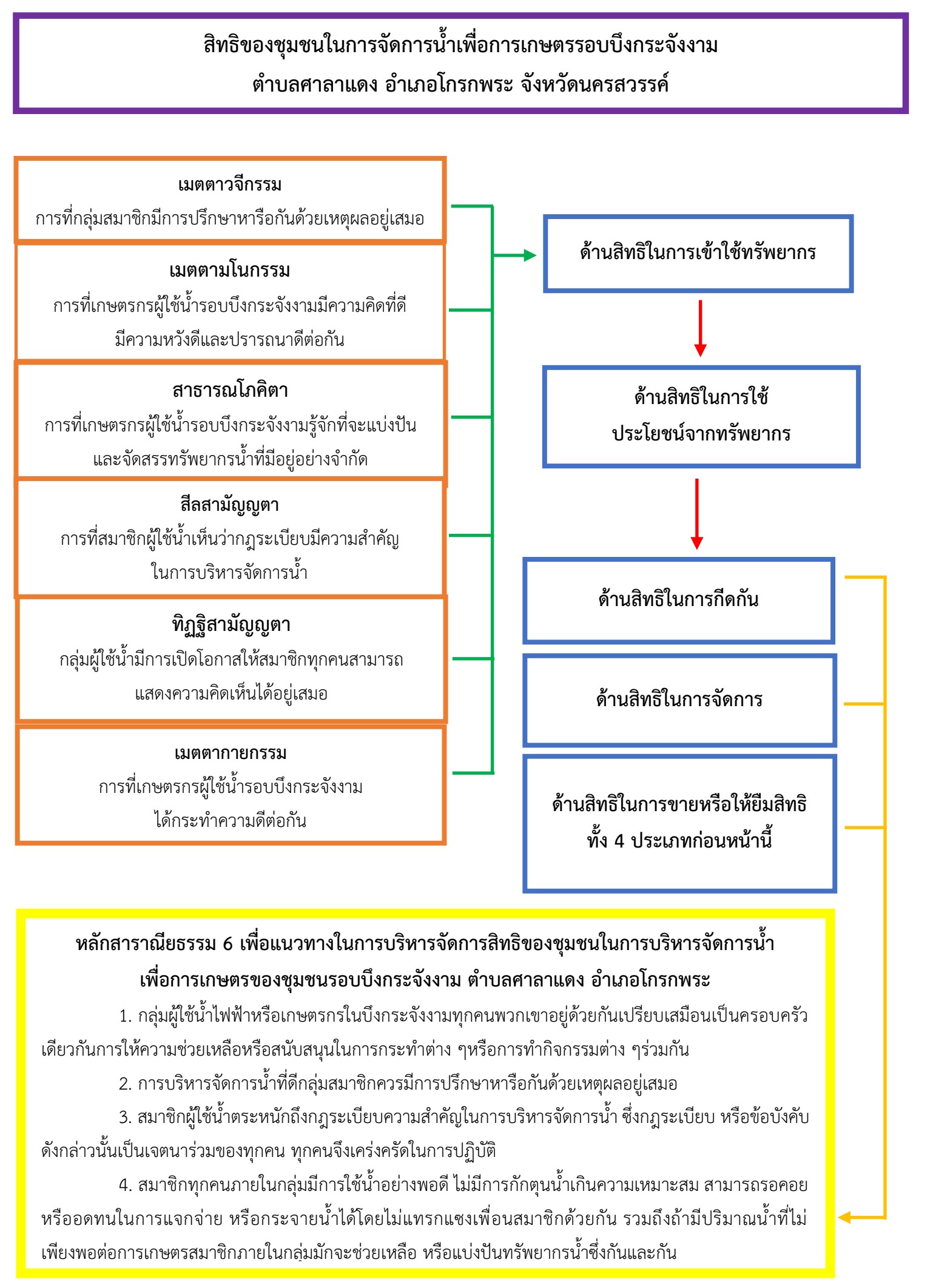
This research aimed to: 1) examine community rights in water management for agricultural purposes around Bueng Krachang Ngam, Sala Daeng Subdistrict, Krok Phra District, Nakhon Sawan Province; 2) analyze the relationship between the principle of Saraniyadhamma and community rights in water management; and 3) propose guidelines for managing community rights in water governance based on the principle of Saraniyadhamma. The study employed a mixed-methods approach, comprising quantitative research using a questionnaire with a reliability coefficient of 0.978, distributed to water users around Bueng Krachang Ngam. The sample size of 319 respondents was determined using Yamane’s formula. The data were analyzed using descriptive statistics, including frequency, percentage, mean, standard deviation, and Pearson’s correlation coefficient. Qualitative research was conducted through in-depth interviews with 21 purposively selected key informants, using a structured interview guide and descriptive content analysis. The findings revealed that the overall level of community rights in water management for agricultural purposes around Bueng Krachang Ngam, based on the principle of Saraniyadhamma, was high, with a mean score of 4.05 (S.D. = 0.69). The level of community rights in water management based on Elinor Ostrom’s common-pool resource management framework was also high, with a mean score of 4.01 (S.D. = 0.57). Moreover, the relationship between the principle of Saraniyadhamma and community rights in water management was found to be statistically significant at the 0.01 level, showing a positive and consistent correlation (r = 0.617**). The study proposed the following guidelines for managing community rights in water governance based on the six principles of Saraniyadhamma: 1) effective water management occurs when all members are able to express their opinions equally, guided by reason and logic; 2) members express gratitude or appreciation when problems in water management are resolved or when contributions benefit the water user group; and 3) members of the water user group are made aware of the rules and the importance of proper water management.
References
กิตติศักดิ์ ปรกติ. (2550). สิทธิของบุคคลซึ่งรวมกันเป็นชุมชน. สำนักงานศาลรัฐธรรมนูญ.
ขนิษฐา ยกซื้อ (2559) การจัดการทรัพยากรธรรมชาติอย่างยั่งยืน: กรณีศึกษา บ้านแม่สะแง๊ะ หมู่ 15 ตำบลทากาศเหนือ อำเภอแม่ทา จังหวัดลำพูน. [วิทยานิพนธ์ระดับปริญญาโทไม่ได้ตีพิมพ์] มหาวิทยาลัยธรรมศาสตร์.
นิตยา โพธิ์นอก และรัชวดี แสงมหะหมัด. (2565). การเสริมสร้างศักยภาพชุมชนเพื่อใช้สิทธิในการจัดการทรัพยากรน้ำอย่างยั่งยืน: กรณีศึกษาชุมชนลุ่มน้ำทะเลสาบสงขลา. สถาบันพระปกเกล้า.
พันธ์ศักดิ์ สายเกียรติวงศ์ และคณะ (2565) ปัจจัยที่มีอิทธิพลต่อการมีส่วนร่วมการใช้ทรัพยากรน้ำ ของกลุ่มผู้ใช้น้ำพื้นที่ลุ่มน้ำเกี๋ยน. วารสารมนุษยศาสตร์และสังคมศาสตร์ มหาวิทยาลัยราชภัฏอุบลราชธานี, 13(2),181-192.
รัฐธรรมนูญแห่งราชอาณาจักรไทย พ.ศ. 2540. (2540, 11 ตุลาคม). ราชกิจจานุเบกษา, เล่ม 114, ตอนที่ 55 ก, หน้า 10.
สำนักงานทรัพยากรน้ำที่ 2. (2567). การติดตั้งเครื่องสูบน้ำ. https://www.facebook.com/ profile/100064870530777/search/?q=%.
อัจฉรี สิงโต. (2565). ภัยแล้งทางการเกษตรของไทย. https://webapp.ldd.go.th/lpd/node _modules/Article_Lpd/Article_Lpd1_1/
อัษฎา บุษบงค์. (2557). การกำหนดกติกาการใช้ประโยชน์ทรัพยากรสัตว์น้ำในป่าพรุฉิมพลีอย่างยั่งยืนโดยการมีส่วนร่วมของชุมชน. (รายงานการวิจัย). โครงการลุ่มน้ำทะเลสาบสงขลา.
อำพา แก้วกำกง และคณะ. (2564) สิทธิชุมชนในการจัดสรรทรัพยากรน้ำโดยใช้แนวทางสันติวิธี: กรณีศึกษาพื้นที่ต้นน้ำของประเทศไทย: รายงานการศึกษาวิจัยฉบับสมบูรณ์. (รายงานการวิจัย). สถาบันวิจัยและให้คำปรึกษาแห่งมหาวิทยาลัยธรรมศาสตร์.
Kongthong, O. & Ratanachai, C. (2012). Civil Society in the Songkla Lake Basin. CRBOM Small Publications Series, 45, 1-9.
Ostrom, E. (2015). Governing the Commons: The Evolution of Institutions for Collective Action. Cambridge University Press.
Downloads
Published
How to Cite
Issue
Section
License
Copyright (c) 2025 Journal of Interdisciplinary Review

This work is licensed under a Creative Commons Attribution-NonCommercial-NoDerivatives 4.0 International License.
1. เนื้อหาและข้อมูลในบทความที่ลงพิมพ์กับวารสารรัฐประศาสนศาสตร์และสหวิทยาเพื่อสังคม (Journal of Public Administration and Interdisciplinary Studies for Society) ถือเป็นข้อคิดเห็น และความรับผิดชอบของผู้เขียนบทความโดยตรงซึ่งกองบรรณาธิการวารสารไม่จำเป็นต้องเห็นด้วย หรือร่วมรับผิดชอบใด ๆ
2. บทความ ข้อมูล เนื้อหา รูปภาพ ฯลฯ ที่ได้รับการตีพิมพ์ในวารสารรัฐประศาสนศาสตร์และสหวิทยาเพื่อสังคม (Journal of Public Administration and Interdisciplinary Studies for Society) ถือเป็นลิขสิทธิ์ของวารสารรัฐประศาสนศาสตร์และสหวิทยาเพื่อสังคม (Journal of Public Administration and Interdisciplinary Studies for Society) หากบุคคลหรือหน่วยงานใดต้องการนำทั้งหมดหรือส่วนหนึ่ง ส่วนใดไปเผยแพร่ต่อหรือเพื่อการกระทำการใด ๆ จะต้องได้รับอนุญาตเป็นลายลักษณ์อักษรจากวารสารรัฐประศาสนศาสตร์และสหวิทยาเพื่อสังคม (Journal of Public Administration and Interdisciplinary Studies for Society) ก่อนเท่านั้น