
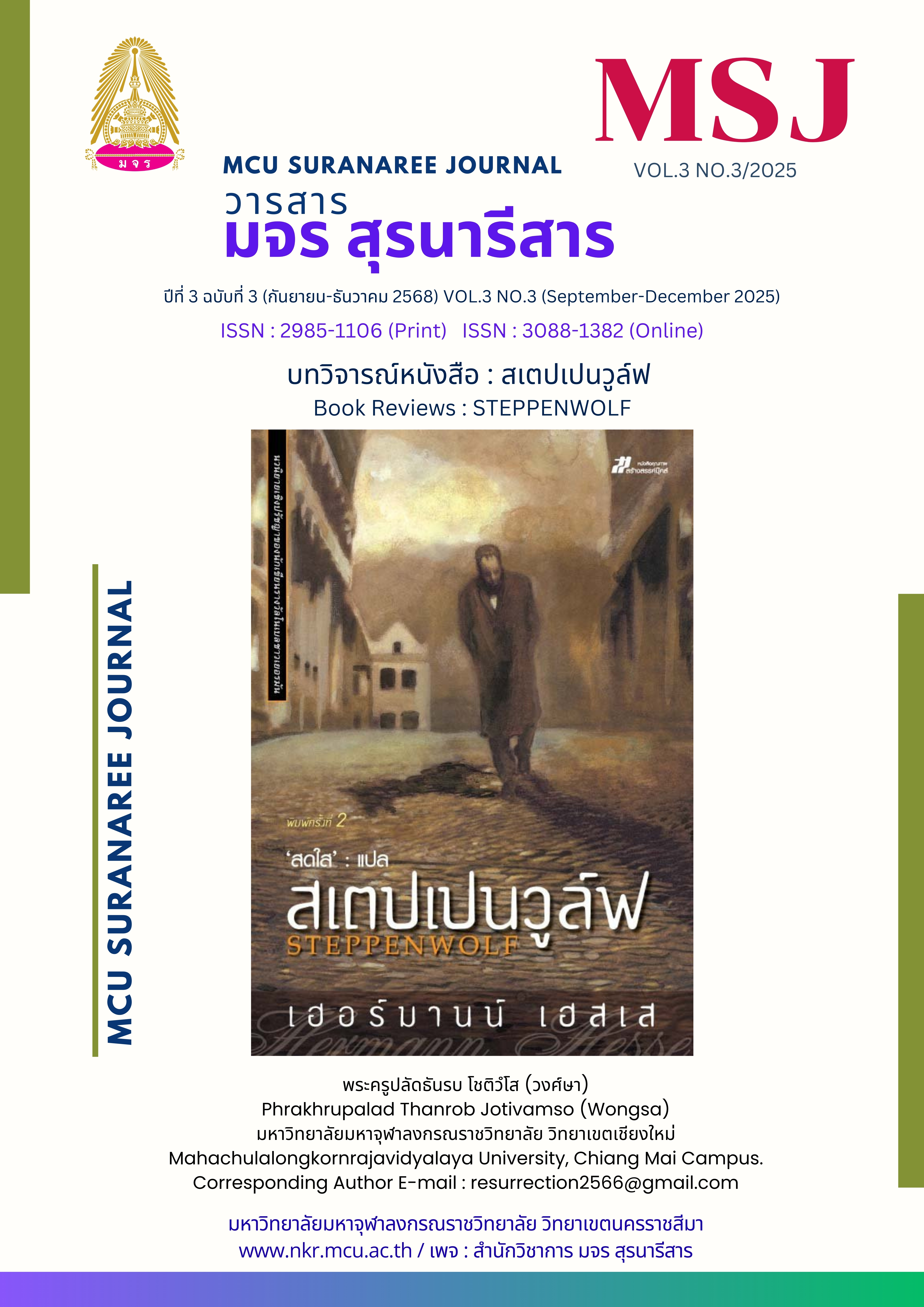
Book Reviews : STEPPENWOLF
Keywords:
Existentialism, Nihilism, Absurdism, Depth psychology, Self-enlightenmentAbstract
Hermann Hesse’s Steppenwolf is an existentialist novel portraying the alienation of modern man through Harry Haller, whose spirit is torn between two poles: the “human” seeking meaning and beauty, and the “wolf” embodying savagery and solitude. The narrative presents two main groups of ideas: (1) philosophies of life’s meaning, including nihilism, existentialism, and absurdism; and (2) Freudian depth psychology, which explores the mind’s darker drives. These concepts align with four branches of philosophy: metaphysics, ethics, aesthetics, and epistemology.
The story’s structure reflects the “opposites” between moral aspiration and moral decay, between animal instinct and human reason, with the “Magic Theater” symbolizing the subconscious and the gateway to self-enlightenment. Steppenwolf is not merely the record of a desperate man, but a mirror of humankind’s struggle with inner conflict. It engages fundamental questions about existence, moral values, and the freedom to choose in a purposeless, irrational world. The text also invites interpretation through Buddhist and Taoist lenses, such as detachment from attachment, awareness of impermanence, and acceptance of opposites in the yin–yang sense.
Ultimately, Steppenwolf is both an account of inner battle and a spiritual journey, calling readers to turn inward in self-exploration while deepening their understanding of the outer world beyond reason.
References
ทองหล่อ วงษ์ธรรมา. (2549). เต๋า : ทางแห่งธรรมชาติ. กรุงเทพมหานคร: สำนักพิมพ์อินเดียนสโตร์.
พระพรหมคุณาภรณ์ (ป.อ. ปยุตโต). (2552). พุทธธรรมฉบับปรับปรุงและขยายความ (พิมพ์ครั้งที่ 11). กรุงเทพมหานคร: มหาวิทยาลัยมหาจุฬาลงกรณราชวิทยาลัย.
มหาจุฬาลงกรณราชวิทยาลัย. (2539). พระไตรปิฎกฉบับภาษาไทย ฉบับมหาจุฬาลงกรณราชวิทยาลัย. กรุงเทพมหานคร: มหาจุฬาลงกรณราชวิทยาลัย.
วิทย์ วิศทเวทย์. (2553). ปรัชญาทรรศน์ : พุทธปรัชญา. กรุงเทพมหานคร: โครงการเผยแผ่ผลงานวิชาการ คณะอักษรศาสตร์ จุฬาลงกรณ์มหาวิทยาลัย.
เหลาจื๊อ. (2537). เต๋า เต็ก เก็ง (โชติช่วง นาดอน, แปล) (พิมพ์ครั้งที่ 3). กรุงเทพมหานคร: ข้าวหอม.
เฮอร์มานน์ เอสเส. (2559). สเตปเปนวูล์ฟ (Steppenwolf) (สดใส ขันติวรพงศ์, แปล; พิมพ์ครั้งที่ 2). กรุงเทพมหานคร: สร้างสรรค์บุ๊คส์.
Berger, P. L. (1967). The sacred canopy: Elements of a sociological theory of religion. Anchor Books.
Camus, A. (1991). The myth of Sisyphus and other essays (J. O'Brien, Trans.). Vintage International. (Original work published 1942).
Chödrön, P. (2002). When things fall apart: Heart advice for difficult times. Shambhala Publications.
Freud, S. (1965). The ego and the id. W. W. Norton & Company.
Hesse, H. (1991). Steppenwolf (R. Manheim, Trans.). Picador. (Original work published 1927).
Jung, C. G. (1968). The archetypes and the collective unconscious (R. F. C. Hull, Trans.). Princeton University Press.
Kierkegaard, S. (1980). The sickness unto death (H. V. Hong & E. H. Hong, Trans.). Princeton University Press. (Original work published 1849).
LaFargue, M. (2013). Buddhism and existentialism: The quest for authentic existence. University of Hawaii Press.
Nietzsche, F. (1967). The birth of tragedy and other writings (R. Speirs, Trans.). Penguin Books.
Sartre, J.-P. (2007). Existentialism is a humanism (C. Macomber, Trans.). Yale University Press. (Original work published 1946).
Downloads
Published
How to Cite
Issue
Section
License
Copyright (c) 2025 MCU Suranaree Journal

This work is licensed under a Creative Commons Attribution-NonCommercial-NoDerivatives 4.0 International License.