
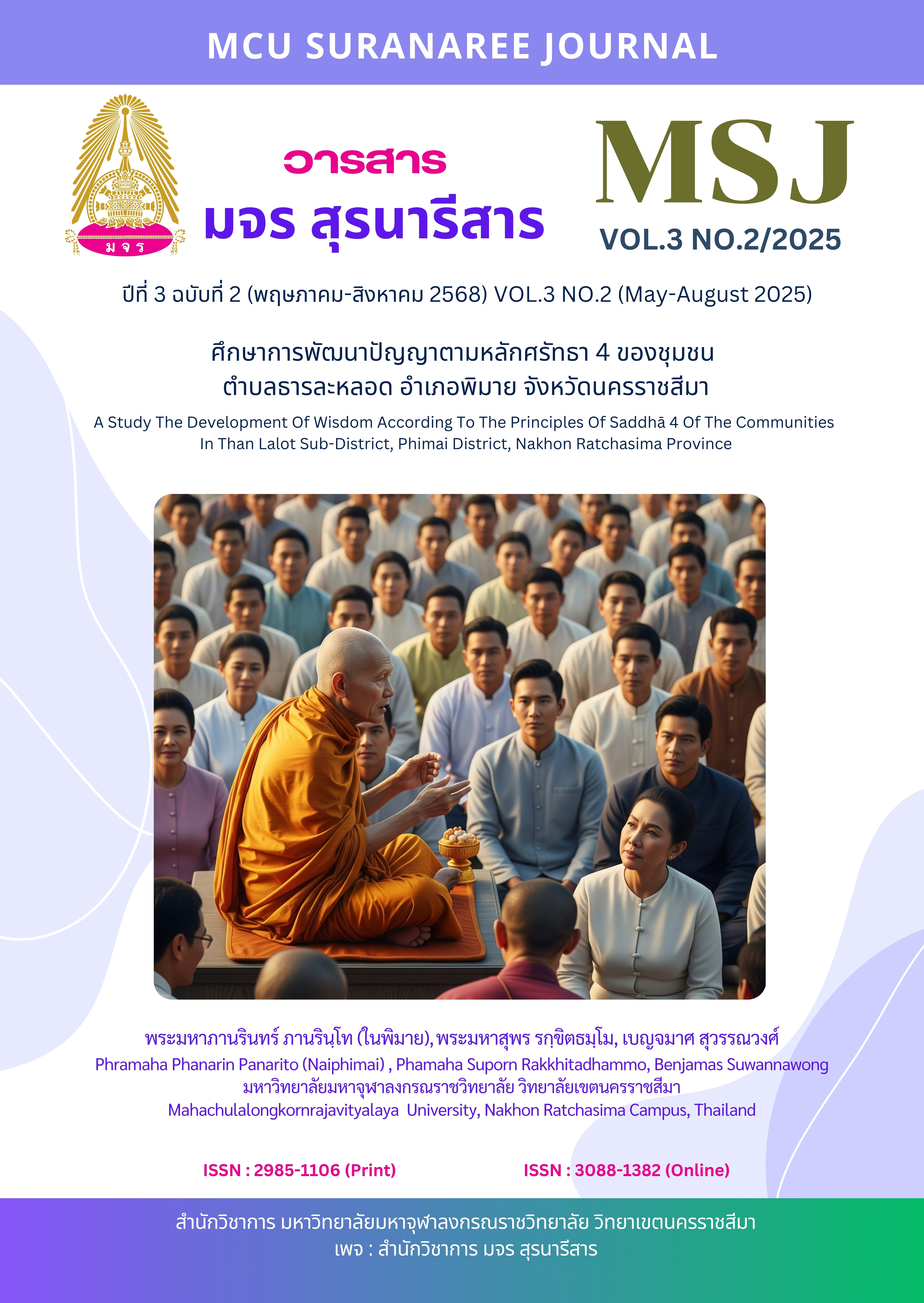
A STUDY THE DEVELOPMENT OF WISDOM ACCORDING TO THE PRINCIPLES OF SADDHA 4 OF THE COMMUNITIES IN THAN LALOT SUB-DISTRICT, PHIMAI DISTRICT, NAKHON RATCHASIMA PROVINCE
ศึกษาการพัฒนาปัญญาตามหลักศรัทธา 4 ของชุมชน ตำบลธารละหลอด อำเภอพิมาย จังหวัดนครราชสีมา
Keywords:
Wisdom Development, Karma, Beliefs, Four Kinds of FaithAbstract
This research article aims to : 1) Study wisdom according to the principles of Theravada Buddhism 2) Examine beliefs based on the Four Kinds of Faith in the community of Thanlalaod Subdistrict, Phimai District, Nakhon Ratchasima Province 3) Investigate the development of wisdom in accordance with the Four Kinds of Faith in the same community. This is a qualitative research study. The findings are as follows:
1) Wisdom in accordance with Theravada Buddhism : The fundamental principles of wisdom development stem from rational beliefs in four aspects (1) Kamma-saddha : believing in the law of karma and that karma truly exists. (2) Vipaka-saddha : believing that all actions inevitably produce results, and that the results of karma truly exist. (3) Kammassakata-saddha : believing that all beings are the owners of their actions and must inevitably receive the consequences according to their own karma and (4) Tathagata-bodhi-saddha : believing in the Enlightenment of the Buddha.
2) Beliefs based on the Four Kinds of Faith in the Thanlalaod community : Faith accompanied by wisdom is based on truth, while faith lacking wisdom is driven by emotion, self-determined judgment, and personal attachment without reasoning, which obstructs wisdom. The highest value of faith is that it leads to practice, achieving inner peace, and ultimately attaining the supreme goal in Buddhism. It was also found that intentional wrongful actions stem from four causes (1) being hot-tempered (2) being impulsive (3) being self-centered and (4) being selfish.
3) Wisdom development in accordance with the Four Kinds of Faith : The community holds rational beliefs in four aspects (1) believing that karma truly exists, and intentional actions are indeed karma (2) believing in the results of karma, that actions inevitably bring consequences and serve as causal conditions (3) believing that each individual is the owner of their karma, responsible for and bound to experience its results and (4) believing that the Tathagata is a fully self-enlightened Buddha. Such beliefs foster a deep understanding of the law of karma as taught in Buddhism.
References
กิจชัย วงศ์ราชและคณะ. (2566). วารสารพุทธศาสตร์ศึกษา, 14(1).
วันชัย สอนศิร.(2567).กระบวนการสร้างศรัทธาและพัฒนาปัญญาตามหลักพระพุทธศาสนาเถรวาท.วารสารสิรินธรปริทรรศน์ ปีที่ 25 ฉบับที่ 1 มกราคม – มิถุนายน 2567.
พระไพศาล วิสาโล. (2552). วิถีสู่สุขภาพทางปัญญา. กรุงเทพมหานคร: ปาปิรุส พับลิเคชั่น.
พระชิโนรส อัคคธัมโม. (2567). วิเคราะห์หลักสมาธิในพระพุทธศาสนาเถรวาท. วารสารปรัชญาปริทรรศน์ ปีที่ 29 ฉบับที่ 2 กรฏาคม – ธันวาคม 2567.
พระธรรมธีรราชมหามุนี (โชดก ญาณสิทฺธิ). (2548). วิปัสสนากรรมฐาน ภาค 1 เล่ม 2 ว่าด้วยวิปัสสนากรรมฐานทั่วไป. กรุงเทพมหานคร: สหธรมิก.
พระธรรมกิตติวงศ์ (ทองดี สุรเตโช) ราชบัณฑิต. (2548). พจนานุกรมเพื่อการศึกษาพุทธศาสนา ชุดคำวัด. กรุงเทพมหานคร: สำนักพิมพ์ช่อระกา.
พระพรหมคุณาภรณ์ (ป.อ. ปยุตฺโต). (2551). พจนานุกรมพุทธศาสน์ ฉบับประมวลศัพท์. พิมพ์ครั้งที่ 11. กรุงเทพมหานคร: บริษัท เอส. อาร์. พริ้นติ้ง แมส โปรดักส์ จำกัด.
พระภาวนาวิริยคุณ (เผด็จ ทตฺตชีโว). ศรัทธา รุ่งอรุณแห่งสันติภาพโลก. พิมพ์ครั้งที่ 2. กรุงเทพมหานคร: บริษัท รุ่งศิลป์การพิมพ์ (1977) จำกัด.
พระมหาโกมล กมโล. (2562). กาย ในภาษาบาลี เครื่องมือการพัฒนาปัญญา. วิทยานิพนธ์พุทธศาสตรมหาบัณฑิต, บัณฑิตวิทยาลัย: บาฬีศึกษาพุทธโฆส, นครปฐม.
มหาวิทยาลัยมหาจุฬาลงกรณราชวิทยาลัย. (2539). พระไตรปิฎกภาษาไทย ฉบับมหาจุฬาลงกรณราชวิทยาลัย. กรุงเทพมหานคร: โรงพิมพ์มหาจุฬาลงกรณราชวิทยาลัย.
_______. (2565). อรรถกาภาษาไทย ฉบับมหาจุฬาลงกรณราชวิทยาลัย. กรุงเทพมหานคร: โรงพิมพ์มหาจุฬาลงกรณราชวิทยาลัย.
ราชบัณฑิตยสถาน. (2556). พจนานุกรม ฉบับราชบัณฑิตยสถาน พ.ศ. 2554, พิมพ์ครั้งที่ 2. กรุงเทพมหานคร: โรงพิมพ์ราชบัณฑิตยสถาน.
สมเด็จพระพุทธโฆษาจารย์ (ป.อ.ปยุตฺโต). (2561) พจนานุกรมพุทธศาสน์ ฉบับประมวลศัพท์. พิมพ์ครั้งที่ 31. กรุงเทพมหานคร: สำนักพิมพ์ผลิธัมม์ จำกัด.
สุชีพ ปุญญานุภาพ(2541). คุณลักษณะพิเศษแห่งพระพุทธศาสนา. พิมพ์ครั้งที่ 2. กรุงเทพมหานคร: มหามกุฏราชวิทยาลัย.
Downloads
Published
How to Cite
Issue
Section
License
Copyright (c) 2025 MCU Suranaree Journal

This work is licensed under a Creative Commons Attribution-NonCommercial-NoDerivatives 4.0 International License.