
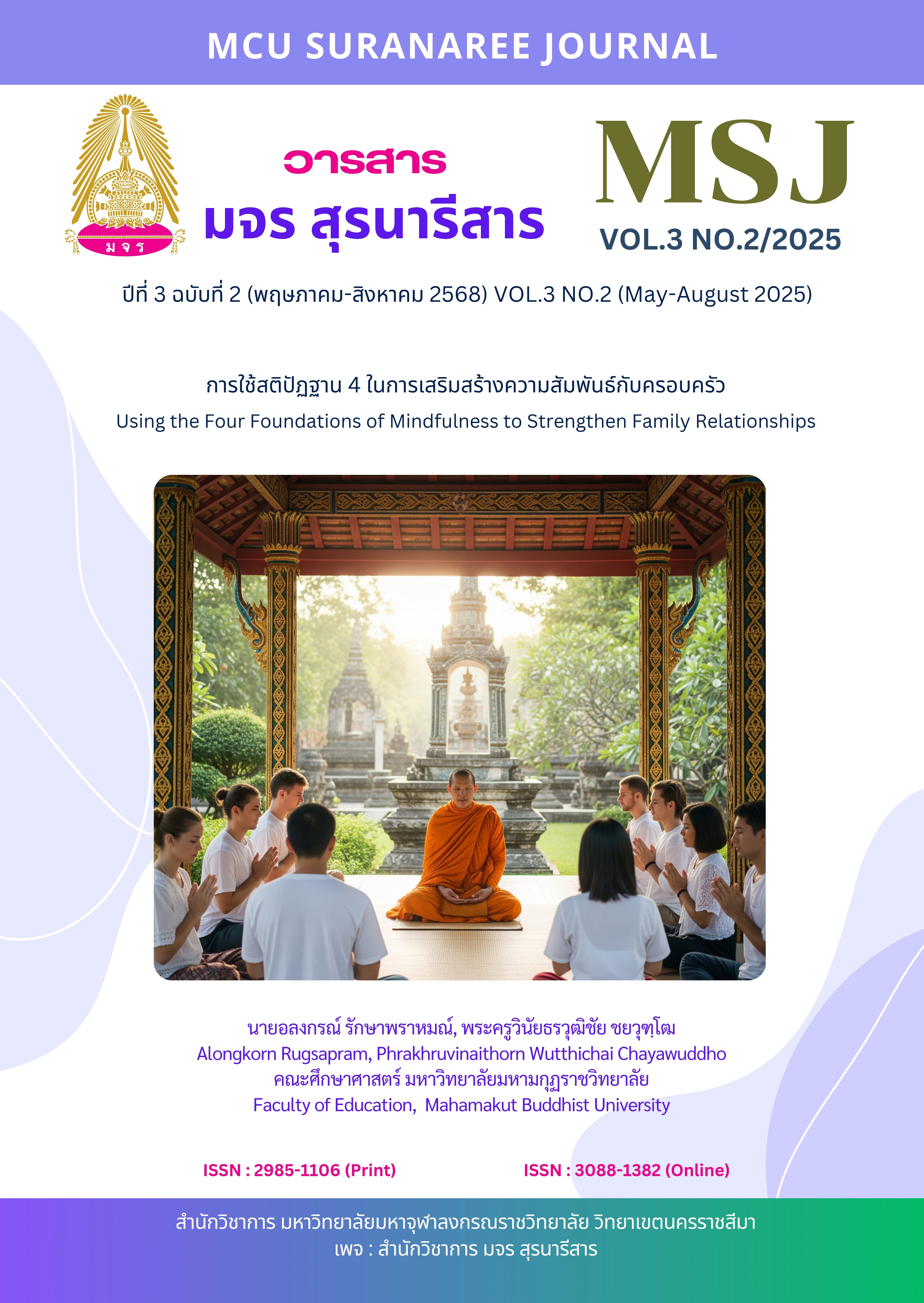
Using the Four Foundations of Mindfulness to Strengthen Family Relationships
Keywords:
Communication, Understanding, Family Relationships, Four Foundations of MindfulnessAbstract
Abstract
This academic article focuses on the application of the Four Foundations of Mindfulness (Satipatthana) in strengthening family relationships. A healthy family relationship is a crucial factor contributing to happiness, mutual understanding, warmth, and the emotional and mental development of family members. One of the major challenges families face today is the lack of effective communication and mutual understanding. Therefore, the concept of applying the Four Foundations of Mindfulness which include mindfulness of the body (kaya), feelings (vedana), mind (citta), and mental objects (dhamma) becomes vital in fostering family relationships. These practices help cultivate awareness of one’s own feelings and the feelings of others, both within and outside the family, enabling more mindful listening and speaking. The study reveals that practicing the Four Foundations of Mindfulness enhances emotional and cognitive awareness, promotes understanding and compassionate communication, and leads to greater self-development and a more meaningful life. This forms the foundation of healthy family relationships by reducing conflicts, increasing empathy, and strengthening emotional bonds, particularly in modern times when families often face a breakdown in deep communication. Consistent mindfulness practice fosters inner peace within the family, paving the way toward stable and sustainable long-term relationships.
References
คณาจารย์มหาวิทยาลัยมหาจุฬาลงกรณราชวิทยาลัย, (2555), ธรรมะภาคปฏิบัติ 1, มหาวิทยาลัยมหาจุฬาลงกรณราชวิทยาลัย.
ปราณี, พ. (2565). ความไว้วางใจและความสัมพันธ์ในสังคมไทย. วารสารจิตวิทยาและสังคม, 9(3), 112-125.
พระพรหมคุณาภรณ์ (ป.อ. ปยุตฺโต), (2552) พจนานุกรมพุทธศาสน์ ฉบับประมวลศัพท์, [ออนไลน์], แหล่งที่มา: http://th. wikipedia. org/wiki/. {7 มกราคม 2568}
วิกิพีเดีย สารานุกรมเสรี, (2557), มหาสติปัฏฐานสูตร, [ออนไลน์], แหล่งที่มา: http://th. wikipedia. org/wiki/ มหาสติปัฏฐานสูตร. {7 มกราคม 2568}
ศรีสมบัติ, ก. (2563). การสื่อสารและความสัมพันธ์ในชุมชน. วารสารการพัฒนาสังคม, 5(1), 34-45.
สมชาย, ว., & วรรณา, น. (2564). การจัดกิจกรรมเพื่อเสริมสร้างความสัมพันธ์ในชุมชน. วารสารการบริหารการพัฒนาชุมชน, 3(2), 67-78.
สร้อยตระกูล อรรถมานะ. (2525). หลักมนุษย์สัมพันธ์. กรุงเทพฯ : มหาวิทยาลัยธรรมศาสตร์.
สุภาวดี ศรีสวัสดิ์. (2563). ปัจจัยที่มีผลต่อความสุขของประชาชนในกรุงเทพมหานคร. วารสารจิตวิทยาและพฤติกรรมศาสตร์, 26(1), 25-40.
สุภีร์ ทุมทอง. (2552). สติปัฏฐาน 4 : เส้นทางตรงสู่พระนิพพาน. กรุงเทพมหานคร: บริษัท ขุมทองอุตสาหกรรมและการพิมพ์จำกัด.
อรรถกถา ทีฆนิกาย. (2552). มหาวรรค มหาสติปัฏฐานสูตร, อรรถกถาพระไตรปิฎก, [ออนไลน์], แหล่งที่มา : http://th.wikipedia. org/wiki/ {7 มกราคม 2568}
Bagwell, C. L., & Schmidt, M. E. (2011). Friendships in Childhood and Adolescence. New York: Guilford Press.
Bowlby, J. (1988). A Secure Base: Parent-Child Attachment and Healthy Human Development. Basic Books.
Cherlin, A. J., & Furstenberg, F. F. Jr. (1986). The New American Grandparent: A Place in the Family, A Life Apart. Basic Books.
Duck, S. (1994). Meaningful relationships: Talking, sense, and relating. Sage.
Dunn, J. (2002). Sibling Relationships. Harvard University Press.
Fehr, B. (1996). Friendship Processes. Thousand Oaks, CA: Sage Publications.
Goleman, D. (1998). Working with emotional intelligence. Bantam Books.
Gottman, J. M., & Silver, N. (1999). The seven principles for making marriage work. Three Rivers Press.
Hartup, W. W., & Stevens, N. (1997). Friendships and adaptation in the life course. Psychological Bulletin, 121(3), 355-370.
Hayes, S. C., Luoma, J. B., Bond, F. W., Masuda, A., & Lillis, J. (2006). Acceptance and commitment therapy: Model, processes and outcomes. Behaviour Research and Therapy, 44(1), 1-25.
Locke, E. A., & Latham, G. P. (2002). Building a practically useful theory of goal setting and task motivation: A 35-year odyssey. American Psychologist, 57(9), 705.
Pahl, R. (2000). On Friendship. Cambridge: Polity Press.
Rawlins, W. K. (2009). The Compass of Friendship: Narratives, Identities, and Dialogues. Thousand Oaks, CA: Sage Publications.
Robbins, S. P., & Judge, T. A. (2013). Organizational behavior. Prentice Hall.
Rossi, A. S., & Rossi, P. H. (1990). Of Human Bonding: Parent-Child Relations Across the Life Course. Aldine de Gruyter.
Smetana, J. G. (2011). Adolescents, families, and social development: How teens construct their worlds. Wiley-Blackwell.
Smith, J. (2022). Techniques for Mindfulness and Breathing Exercises. Mindfulness Journal, 12(3), 45-48.
Sternberg, R. J. (1986). A triangular theory of love. Psychological Review, 93(2), 119–135. [Online], Revealed : https://doi.org/10.1037/0033-295X.93.2.119 {January 7, 2025}
Tudor-Locke, C., Schuna, J. M., Jr., Barreira, T. V., Mire, E. F., & Katzmarzyk, P. T. (2015). Improving the public health relevance of adults’ accelerometer-determined activity: A new metric. Medicine and Science in Sports and Exercise.
Downloads
Published
How to Cite
Issue
Section
License
Copyright (c) 2025 MCU Suranaree Journal

This work is licensed under a Creative Commons Attribution-NonCommercial-NoDerivatives 4.0 International License.