
Affective and Explainable Artificial Intelligence-Driven Human-in-the-Loop Adaptive Learning Model to Enhance Cognitive and Innovation Competencies
คำสำคัญ:
Affective Artificial Intelligence, Explainable Artificial Intelligence, Human-in-the-Loop, Adaptive Learning, Cognitive Competency, Innovation Competencyบทคัดย่อ
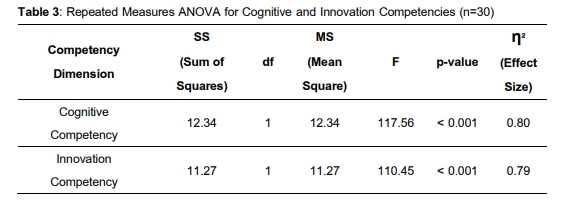
This study aimed to develop and evaluate an Artificial Intelligence (AI)-driven adaptive learning model that integrates Affective AI (AAI), Explainable AI (XAI), and Human-in-the-Loop (HITL) to enhance participants’ competencies in critical thinking and innovation. The research was conducted in three phases: (1) reviewing relevant concepts, theories, and empirical studies to determine the components of the adaptive learning model; (2) developing the model and validating its appropriateness through expert review; and (3) implementing the model with a sample of 30 professional development participants. Data were collected using standardized instruments measuring critical thinking and innovation competencies, and were analyzed using Paired Samples t-test and Repeated Measures ANOVA. The findings revealed that the developed adaptive learning model demonstrated a high level of appropriateness, both in terms of comprehensiveness of its components and practical feasibility. Furthermore, participants’ post-test mean scores in critical thinking and innovation competencies were significantly higher than their pre-test scores (p < 0.001). This indicates that the model effectively enhanced personalized, transparent, and learner-centered processes. In conclusion, the integration of Affective AI, Explainable AI, and Human-in-the-Loop shows strong potential in establishing adaptive learning systems that foster key 21st-century competencies among professionals, with implications for both theoretical advancement and practical application.
Downloads
เอกสารอ้างอิง
Johnson, L., Becker, S. A., Cummins, M., Estrada, V., & Freeman, A. (2022). The NMC Horizon report: 2022 higher education edition. EDUCAUSE.
Holmes, W., Bialik, M., & Fadel, C. (2019). Artificial intelligence in education: Promises and implications for teaching and learning. Center for Curriculum Redesign.
Siemens, G., & Long, P. (2021). Learning analytics and adaptive learning. EDUCAUSE Review, 56(1), 23–34.
Calvo, R. A., & D’Mello, S. K. (2022). Affective computing and intelligent interaction in education. MIT Press.
Woolf, B. P., Arroyo, I., & Cooper, D. G. (2021). Affective learning companions: Strategies for empathetic agents. International Journal of Artificial Intelligence in Education, 31(2), 245–270. https://doi.org/10.1007/s40593-020-00227-3
Holmes, W., Porayska-Pomsta, K., Holstein, K., Sutherland, E., Baker, T., & Lindsay, S. (2022). Ethics of AI in education: Towards a community-wide framework. British Journal of Educational Technology, 53(4), 675–692. https://doi.org/10.1111/bjet.13191
Shen, J., Li, Y., & Yang, Q. (2023). Explainable artificial intelligence for education: A systematic review. Computers & Education, 193, 104662. https://doi.org/10.1016/j.compedu.2022.104662
Dellermann, D., Calma, A., Lipusch, N., Weber, T., Weigel, S., & Ebel, P. (2019). The future of human-AI collaboration: A taxonomy of design knowledge for hybrid intelligence systems. International Conference on Information Systems (ICIS), 1–17.
Holstein, K., Wortman Vaughan, J., Daumé, H., Dudik, M., & Wallach, H. (2020). Improving fairness in machine learning systems: What do industry practitioners need? Proceedings of the 2020 CHI Conference on Human Factors in Computing Systems, 1–16. https://doi.org/10.1145/3313831.3376447
Williamson, B., & Eynon, R. (2020). Historical threads, missing links, and future directions in AI in education. Learning, Media and Technology, 45(3), 223–235. https://doi.org/10.1080/17439884.2020.1798995
Luckin, R. (2021). The implications of artificial intelligence for education. Oxford Review of Education, 47(5), 584–602. https://doi.org/10.1080/03054985.2021.1916900
D’Mello, S., & Graesser, A. (2015). Feeling, thinking, and computing with affect-aware learning technologies. In R. A. Calvo, S. D’Mello, J. Gratch, & A. Kappas (Eds.), The Oxford Handbook of Affective Computing (pp. 419–434). Oxford University Press.
Miller, T. (2019). Explanation in artificial intelligence: Insights from the social sciences. Artificial Intelligence, 267, 1–38.
World Economic Forum. (2020). The future of jobs report 2020. World Economic Forum.
Chen, L., Chen, P., & Lin, Z. (2020). Artificial intelligence in education: A review. IEEE Access, 8, 75264–75278.
https://doi.org/10.1109/ACCESS.2020.2988510
Anderson, L. W., & Krathwohl, D. R. (Eds.). (2001). A taxonomy for learning, teaching, and assessing: A revision of Bloom’s taxonomy of educational objectives. New York, NY: Longman.
Calvo, R. A., & D’Mello, S. (2019). Affect detection: An interdisciplinary review of models, methods, and their applications. IEEE Transactions on Affective Computing, 10(1), 18–37.
https://doi.org/10.1109/TAFFC.2017.2740923
Gunning, D., Stefik, M., Choi, J., Miller, T., Stumpf, S., & Yang, G. Z. (2019). XAI—Explainable artificial intelligence. Science Robotics, 4(37), eaay7120.
Anderson, T., & Shattuck, J. (2012). Design-based research: A decade of progress in education research? Educational Researcher, 41(1), 16–25.
OECD. (2018). OECD learning framework 2030: The future of education and skills. Paris: OECD Publishing.
Dyer, J., Gregersen, H. B., & Christensen, C. M. (2011). The innovator’s DNA: Mastering the five skills of disruptive innovators. Boston, MA: Harvard Business Review Press.
Wu, Y., Wu, B., Chen, N. S., & Gao, M. (2022). Human-in-the-loop machine learning in education: A review and perspectives. Computers and Education: Artificial Intelligence, 3, 100066.
Bloom, B. S. (1956). Taxonomy of educational objectives: The classification of educational goals. Handbook I: Cognitive domain. New York, NY: Longmans, Green.
ดาวน์โหลด
เผยแพร่แล้ว
รูปแบบการอ้างอิง
ฉบับ
ประเภทบทความ
สัญญาอนุญาต
ลิขสิทธิ์ (c) 2025 วารสารวิจัยและนวัตกรรมทางการศึกษาอุตสาหกรรม

อนุญาตภายใต้เงื่อนไข Creative Commons Attribution-NonCommercial-NoDerivatives 4.0 International License.
บทความนี้ได้รับการเผยแพร่ภายใต้สัญญาอนุญาต Creative Commons Attribution-NonCommercial-NoDerivatives 4.0 International (CC BY-NC-ND 4.0) ซึ่งอนุญาตให้ผู้อื่นสามารถแชร์บทความได้โดยให้เครดิตผู้เขียนและห้ามนำไปใช้เพื่อการค้าหรือดัดแปลง หากต้องการใช้งานซ้ำในลักษณะอื่น ๆ หรือการเผยแพร่ซ้ำ จำเป็นต้องได้รับอนุญาตจากวารสาร