
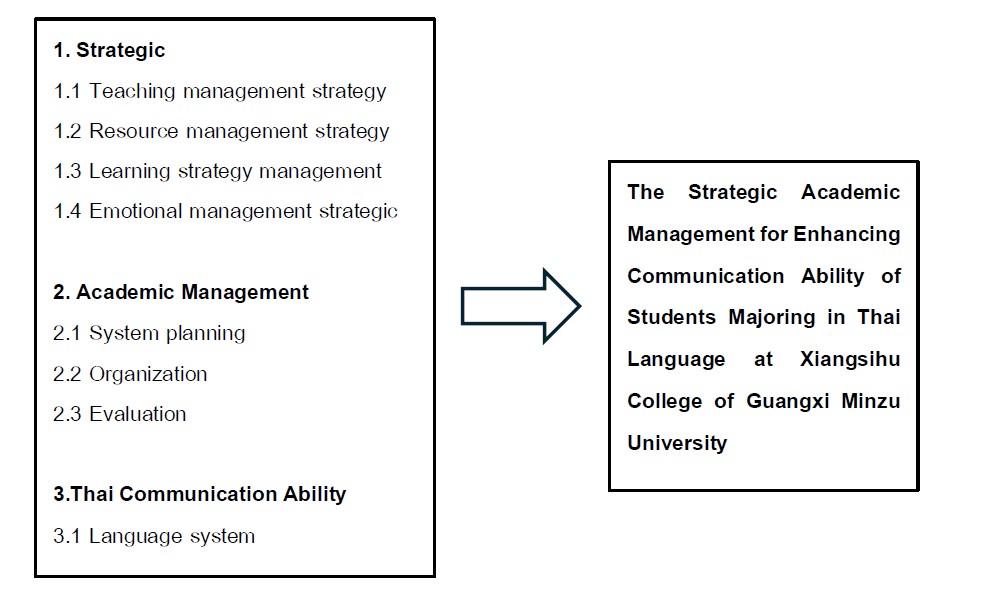
The Strategic Academic Management for Enhancing Communication Ability of Students Majoring in Thai Language at Xiangsihu College of Guangxi Minzu University
DOI:
https://doi.org/10.14456/jriie.2025.6คำสำคัญ:
Strategy, Academic management, Thai communicationบทคัดย่อ
This study investigated communication problems and needs among Thai majors at Xiangsihu College of Guangxi Minzu University and developed strategic to enhance their Thai communication. Using a mixed-methods design, data were collected from students and teachers through questionnaires and interviews. The findings revealed major barriers in language system, cultural connotation, and conversational meaning, caused by outdated resources and limited speaking opportunities. To address these issues, the study proposes a strategic academic management framework consisting of curriculum adjustment, innovative teaching methods with technology integration, teacher development and collaboration, scientific evaluation and personalized feedback, and resource and policy support. The framework contributes practical implications for improving Thai communication education and cultivating small-language talents under the “Belt and Road” initiative.
Downloads
เอกสารอ้างอิง
Huang, Y. (2016). Understanding China's Belt & Road initiative: Motivation, framework and assessment. China Economic Review, 40, 314–321.
Ma, H., & Liu, H. (2019). One Belt and One Road implementation and new international talent cultivation. Retrieved from https://webofproceedings.org/proceedings_series/article/ artId/10271.html
Khalifa, A. S. (2021). Strategy, nonstrategy and no strategy. Journal of strategy and management,14(1),35-49.
Iamudom, T., & Tangkiengsirisin, S. (2020). A comparison study of learner autonomy and language learning strategic among Thai EFL learners. International Journal of Instruction, 13(2), 199–212. https://doi.org/10.29333/iji.2020.13214a
Vargas‑Hernández, J. G., & Vargas‑González, O. C. (2022). Strategic for meaningful learning in higher education. Journal of Research in Instructional, 2(1), 47–64.
Navarro Montaño, M. J., Piñero Virué, R., Jiménez Navarro, P., & Mateo Navarro, V. (2024). Discussion groups in teacher training: Analysis of inclusive didactic strategic. South Florida Journal of Development, 5(9), 1–18. https://doi.org/10.46932/sfjdv5n9-045
Xu, W., Zhang, H., Sukjairungwattana, P., & Wang, T. (2022). The roles of motivation, anxiety and learning strategic in online Chinese learning among Thai learners of Chinese as a foreign language. Frontiers in Psychology, 13, 962492. https://doi.org/10.3389/fpsyg.2022.962492
Marwan, R. H., Usman, N., & Omar, K. (2024). Management of academic services at the Faculty of Social Sciences and Government Sciences UIN Ar-Raniry Banda Aceh. Nidhomul Haq, 9(2), 301–312.
Landa Agurto, C. (2024). Design of an academic management model for the training of entrepreneurs. Universidad, Ciencia y Tecnología, 141–151.
Salam, I. A., & Syaifuddin, M. (2023). Konsep dasar manajemen akademik di perguruan tinggi Islam [Basic concepts of academic management in Islamic higher education]. Al-Fahim: Jurnal Manajemen Pendidikan Islam, 5(1), 222–238. (in Indonesian)
Basri, H., Nurhayuni, N., Algusyairi, P., & Syaifuddin, M. (2023). Manajemen akademik dan kualitas pendidikan: Sebuah kajian mendalam membagun kepemimpinan [Academic management and education quality: A deep study on leadership development]. EDUKASIA: Jurnal Pendidikan dan Pembelajaran, 4(2), 2689–2696. (in Indonesian)
Rokhman, R., Diana, N., Etek, Y., Koderi, K., & Sufian, M. (2024). The development of a scientific-based academic supervision management model. AL-ISHLAH: Jurnal Pendidikan, 16(2), 1383–1398.
Chaya, P., & Inpin, B. (2020). Effects of integrating movie-based mobile learning instruction for enhancing Thai university students' speaking skills and intercultural communicative competence. English Language Teaching, 13(7), 27–45. https://doi.org/10.5539/elt.v13n7p27
Wiboolyasarin, W., Wiboolyasarin, K., & Jinowat, N. (2020). Learners’ oral corrective feedback perceptions and preferences in Thai as a foreign language tertiary setting. Journal of Language and Linguistic Studies, 16(2), 912–929.
Zerfass, A., Verčič, D., Nothhaft, H., & Werder, K. P. (2020). Strategic communication: Defining the field and its contribution to research and practice. In Future directions of strategic communication. Routledge.
Coombs, W. T. (2020). Conceptualizing crisis communication. In Handbook of risk and crisis communication. Routledge. Retrieved from Taylor & Francis Online
Raha, T., & Wongsapan, M. (2024). Development of an instructional model to enhance competency in the Thai language for grade 6 students. Journal of Education and Learning, 13(2), 119–129. https://doi.org/10.5539/jel.v13n2p119
Elder, C.-H., & Haugh, M. (2018). The interactional achievement of speaker meaning: Toward a formal account of conversational inference. Intercultural Pragmatics, 15(5), 593–625.
Killen, R., & O’Toole, M. (2023). Effective Teaching Strategic: Lessons from Research and Practice (8th ed.). Cengage Learning Australia.
Loon, M., Evans, J., & Kerridge, C. (2015). Learning with a strategic management simulation game: A case study. The International Journal of Management Education, 13(3), 227–236.
Hounsell, D. (2003). The evaluation of teaching. London: Kogan Page.
ดาวน์โหลด
เผยแพร่แล้ว
รูปแบบการอ้างอิง
ฉบับ
ประเภทบทความ
สัญญาอนุญาต
ลิขสิทธิ์ (c) 2025 วารสารวิจัยและนวัตกรรมทางการศึกษาอุตสาหกรรม

อนุญาตภายใต้เงื่อนไข Creative Commons Attribution-NonCommercial-NoDerivatives 4.0 International License.
บทความนี้ได้รับการเผยแพร่ภายใต้สัญญาอนุญาต Creative Commons Attribution-NonCommercial-NoDerivatives 4.0 International (CC BY-NC-ND 4.0) ซึ่งอนุญาตให้ผู้อื่นสามารถแชร์บทความได้โดยให้เครดิตผู้เขียนและห้ามนำไปใช้เพื่อการค้าหรือดัดแปลง หากต้องการใช้งานซ้ำในลักษณะอื่น ๆ หรือการเผยแพร่ซ้ำ จำเป็นต้องได้รับอนุญาตจากวารสาร