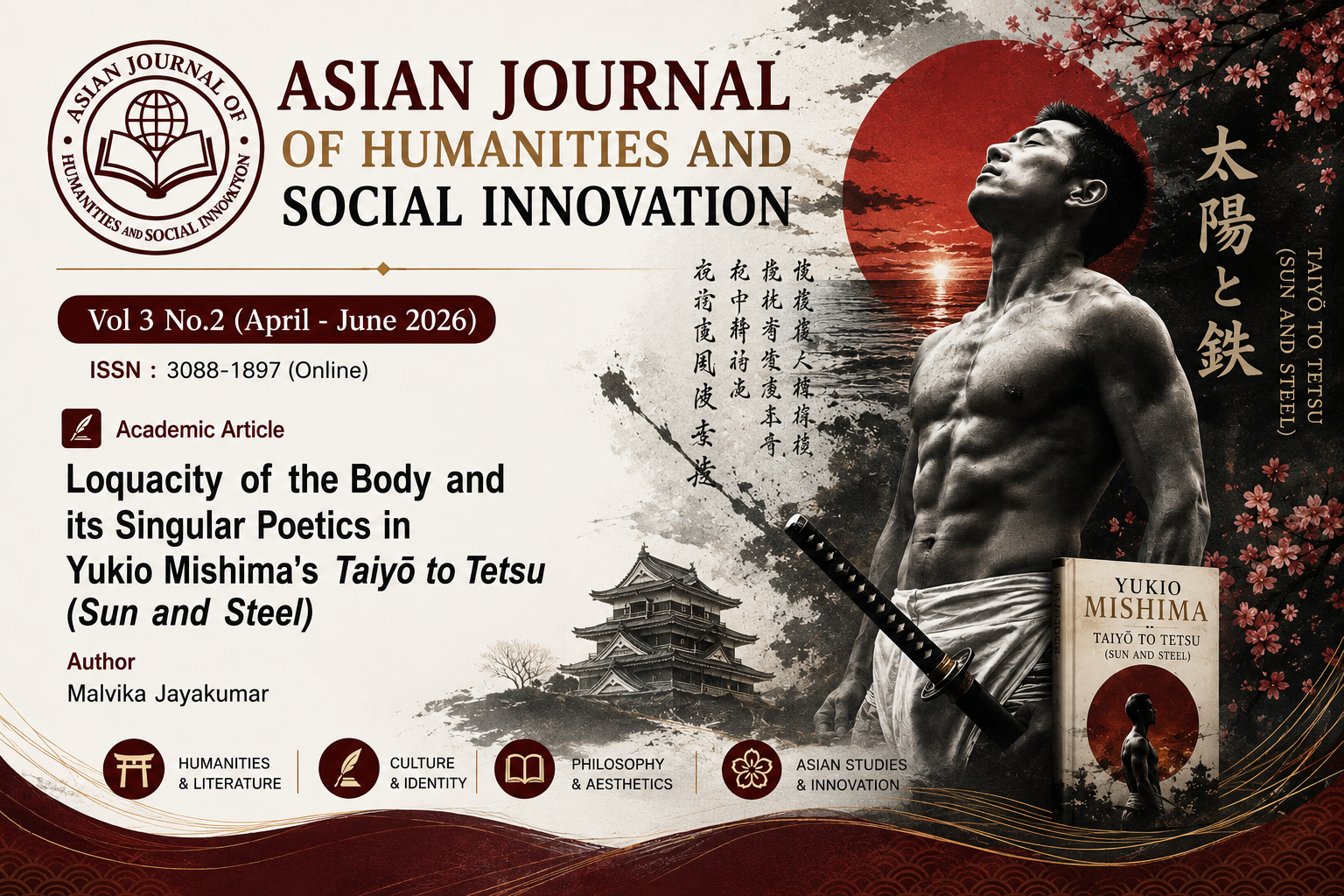
Loquacity of the Body and its Singular Poetics in Yukio Mishima’s Taiyō to Tetsu (Sun and Steel)
Keywords:
Postcritique, Mishima, Postcritique, Mishima, BodyAbstract
The body is often the receptacle for formulaic modes of literary criticism, whether as a template for political concepts like the Nation or as a physical reflection of inner turmoil or class struggle. This predictable modus operandi of literary criticism in viewing the body leaves limited space for exploring the material experiences of the body. The Cartesian mind-body binary in representing the body relegates the body to an inferior status. Japanese author Yukio Mishima rejects this conventional treatment of the body in his autobiographical essay Taiyō to Tetsu (1990), as he creates an aesthetic theory premised on the material body and syncretises body and spirit in his quest for perfection. While Mishima’s reputation is marred by his sadistic “…perversions and quasi-fascistic politics…especially after he committed ritual suicide,” this article, through a reading of his essay, strives to explore the postcritical turn in Mishima’s understanding of the body. Even while eliciting polarising reactions to his works and life, Mishima’s views on the material body strongly indicate a unique critical tradition (Piven, 2001, p. 771). Reading Mishima from this lens leads to complex questions about the role of the critic in unearthing fresh grounds for analysis and the possibility for gleaning unique ideas from the text.
References
Anderson, Linda. (2001). Personal Criticism. In Drakakis, J. (Ed.), Autobiography. (pp. 121—126). Routledge.
Anker, E. & Felski, R. (Eds.). (2017). Introduction. In Critique and Postcritique. (pp. 1—31). Duke University Press.
Britannica. (n.d.). Seppuku. https://www.britannica.com/topic/seppuku.
Canovan, M. (1998). Introduction. In The Human Condition. (pp. vii—xx). University of Chicago Press.
Dalal, N. (n.d.). Śaṅkara. In Zalta, E (Ed.), The Stanford Encyclopedia of Philosophy. https://plato.stanford.edu/archives/win2021/entries/shankara/.
Derrida, J. (1988). Structure, sign and play in the discourse of the human sciences. Modern Criticism and Theory: a reader, 107—123.
Hurst III, G. C. (1990). Death, Honor and Loyalty: The Bushido Ideal. Philosophy East and West, 40(4), 511—527. https://www.jstor.org/stable/1399355.
Igarashi, Yoshikuni. (2000). Bodies of Memory: Narratives of War in Postwar Japanese Culture, 1945-1970. Princeton University Press.
Kant, I. (1922). Critique of Pure Reason. Müller, F.M. (Trans.). The Macmillan Company.
Latour, B. (2004). Why has Critique Run out of Steam? From Matters of Fact to Matters of Concern. Critical Inquiry, 30(2), 225—248. http://www.jstor.org/stable/10.1086/421123.
Marmysz, John. (2017). Yukio Mishima and the Return to the Body. In Cinematic Nihilism: Encounters, Confrontations, Overcomings. (pp. 177—203). Edinburgh University Press.
McKinney, M. (2010). Introduction. In Kokoro. (pp. 1—7). Penguin Books.
Mishima, Y. (1990). Taiyō to Tetsu. Bester, J. (Trans.). Kodansha.
---. (1995). Yūkoku. In Sargent, G. (Trans.), Death in Summer and Other Stories. (pp. 93—118). New Directions.
Piven, J. (2001). Phallic Narcissism, Anal Sadism, and Oral Discord: The Case of Yukio Mishima, Part I. The Psychoanalytic Review, 88(6), 771—791. https://guilfordjournals.com/doi/abs/10.1521/prev.88.6.771.17713?journalCode=prev.
---. (2002). Narcissistic Revenge and Suicide: The Case of Yukio Mishima, Part II. The Psychoanalytic Review, 89(1), 49—77. https://guilfordjournals.com/doi/abs/10.1521/prev.89.1.49.23402?journalCode=prev.
Pletcher, K. (n.d.). Bushidō. Encyclopedia Britannica. https://www.britannica.com/topic/Bushido.
Rohlf, M. (n.d.). Immanuel Kant. In Zalta, E. (Ed.), The Stanford Encyclopedia of Philosophy. https://plato.stanford.edu/archives/fall2020/entries/kant/.
Takehiko, N. & Craig, T. (1984). Mishima Yukio and Kita Ikki: The Aesthetics and Politics of Ultranationalism in Japan. The Journal of Japanese Studies, 10(2), 437—454. https://www.jstor.org/stable/pdf/132145.pdf.
Wagenaar, D. & Iwamoto, Y. (1975). Yukio Mishima: Dialectics of Mind and Body. Contemporary Literature, 16(1), 41—60. https://www.jstor.org/stable/1207783.
Wikipedia. (n.d.). Nitobe Inazō. https://en.wikipedia.org/wiki/Nitobe_Inaz%C5%8D.
Wordsworth, W. (1909). Preface to Lyrical Ballads. In Eliot, C. (Ed.), Prefaces and Prologues to Famous Books [The Harvard Classics]. (pp. 283—306). PP Collier and Son.
Downloads
Published
How to Cite
Issue
Section
License
Copyright (c) 2026 Asian Journal of Humanities and Social Innovation

This work is licensed under a Creative Commons Attribution-NonCommercial-NoDerivatives 4.0 International License.
This article is published under a Creative Commons Attribution-NonCommercial-NoDerivatives 4.0 International License (CC BY-NC-ND 4.0), which allows others to share the article with proper attribution to the authors and prohibits commercial use or modification. For any other reuse or republication, permission from the journal and the authors is required.