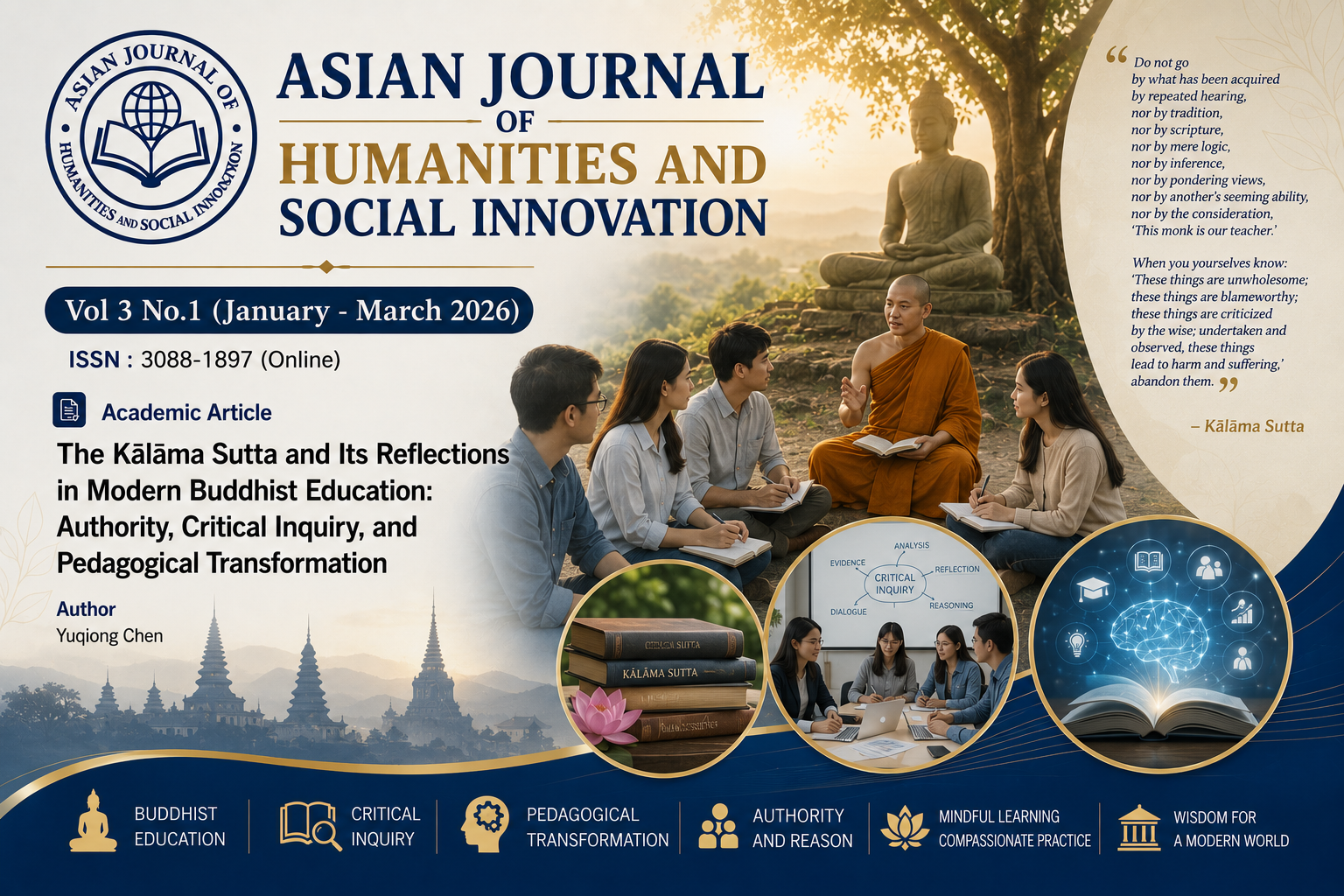
The Kālāma Sutta and Its Reflections in Modern Buddhist Education: Authority, Critical Inquiry, and Pedagogical Transformation
Keywords:
Kālāma Sutta, Modern Buddhist education, Critical inquiry, Buddhist epistemology, Religious pedagogy, Educational philosophy, Experiential learningAbstract
Employing qualitative textual analysis of Pāli canonical sources combined with conceptual analysis of modern pedagogical frameworks, this paper examines the Kālāma Sutta (Aṅguttara Nikāya, 3.65), as well as modern pedagogy within Buddhism, to clarify what methods and means are taught in the Kālāma Sutta for learning about the Dharma. The analysis focuses on the sutta’s critique of uncritical deference to tradition and authority. The study also considers the moral and empirical standards that the Buddha recommends for decision-making and knowledge acquisition. These findings suggest that the sutta offers a pedagogical model that is grounded in critical inquiry, personal experience, ethics rather than dogma, and a willingness to make mistakes. This study shows how it is possible to break the rigidity of tradition by using this method, enabling a balanced integration of critical thinking, practice-based learning, and moral cultivation in response to the challenges of modernity.
References
Baker, C. R. (1996). Reflective learning: A teaching strategy for critical thinking. Journal of Nursing Education, 35(1), 19–22.
Bodhi, B. (1998). A look at the Kālāma Sutta. Access to Insight. https://www.accesstoinsight.org/lib/authors/bodhi/bps-essay_09.html
Bodhi, B. (2005). In the Buddha's words: An anthology of discourses from the Pāli Canon. Wisdom Publications.
Bodhi, B. (2012). The numerical discourses of the Buddha: A complete translation of the Aṅguttara-Nikāya. Wisdom Publications.
Bogacz, S. (2024). Buddhist epistemology and the Liar paradox. Australasian Journal of Philosophy, 102(1), 206–220. https://doi.org/10.1080/00048402.2023.2189889
Bogacz, S., & Tanaka, K. (2023). Dharmakīrtian inference. Journal of Indian Philosophy, 51(4), 591–609. https://doi.org/10.1007/s10781-023-09509-5
Buddhadāsa Bhikkhu. (1988). Help! The Kālāma Sutta, help! Dhamma Talks.
http://www.dhammatalks.net/Books5/Bhikkhu_Buddhadasa_Help_The_Kalama_Sutta_Help.htm
Buddhaghosa. (1995). Aṭṭhasālinī: The exposition of the meaning (Pe Maung Tin, Trans.). Pali Text Society. (Original work composed 5th century CE)
Buddhaghosa. (1961). Manorathapūraṇī: Commentary on the Aṅguttara Nikāya (Vol. 1) (M. Walleser & H. Kopp, Eds.). Pali Text Society. (Original work composed 5th century CE)
Buddhaghosa. (1979). Manorathapūraṇī: Commentary on the Aṅguttara Nikāya (Vol. 2-3) (H. Kopp, Ed.). Pali Text Society. (Original work composed 5th century CE)
Chongla-iat, P. (2023). Buddhist methods of educational approach. Journal of Buddhist Anthropology, 8(3), 202–211. https://doi.org/10.26759/jbsba.v8i3.267932
Changlian, (2022). A Discussion on Buddhist Education, Monastic Talent Cultivation and the Development of Buddhist Colleges in Guangdong. In Proceedings of the Symposium on the 40th Anniversary of the Guangdong Buddhist Association and the Promotion of the Sinicization of Buddhism in Guangdong (II)(pp.692–704). Guangdong Buddhist Association.
Chuanming. (2022). A discussion on meditation education at the Guangdong Buddhist College. In Proceedings of the symposium on the 40th anniversary of the Guangdong Buddhist Association and the promotion of the Sinicization of Buddhism in Guangdong (II) (pp. 545–553). Guangdong Buddhist Association.
Dreyfus, G., & Lindtner, C. (1989). The Yogācāra philosophy of Dignāga and Dharmakīrti. Studies in Central and South East Asian Religions, 2, 27–52.
Evans, S. A. (2007). Doubting the Kālāma-Sutta: Epistemology, ethics, and the “Sacred.” Buddhist Studies Review, 24(1), 91–107. https://doi.org/10.1558/bsrv.v24i1.91
Goffe, L. C., & Deane, N. H. (1974). Questioning our questions. College Composition and Communication, 25(4), 284–291. https://doi.org/10.2307/356420
Hakamaya, N. (2006). The thought of “Critical Buddhism” (Hihan Bukkyō). The Eastern Buddhist, 37(1–2), 80–107.
Hayes, R. P. (1980). Dignāga's view on reasoning: Svārthānumāna. Journal of Indian Philosophy, 8(3), 219–277. https://doi.org/10.1007/BF00165568
He, M. (2005). A Review of the Monastic Education Situation in Contemporary Taiwan Buddhist Colleges. Voice of Dharma, (6), 6-11. DOI: CNKI:SUN:FYZZ.0.2005-06-011
Horner, I. B. (Trans.). (2020). The middle length sayings (Majjhima Nikāya) (J. A. Pali Text Society, Ed.). Pali Text Society. (Original work published 1954–1959)
Keown, D. (2000). Buddhism: A very short introduction. Oxford University Press.
Kolb, D. A. (2014). Experiential learning: Experience as the source of learning and development (2nd ed.). Pearson Education.
Le, N. C. (2018). A hermeneutical study of the ways the Buddha answers: Comparing Soma Thera and Bhikkhu Bodhi on the Kālāma Sutta [Doctoral dissertation, University of the West]. ProQuest Dissertations and Theses Global.
Lijing. (2007). Buddhist Culture and Education. China Religious Culture Publisher.
Li, L. N. (2022). Thoughts on strengthening Buddhist talent cultivation in Guangdong from the perspective of Sinicization of Buddhism. In Proceedings of the symposium on the 40th anniversary of the Guangdong Buddhist Association and the promotion of the Sinicization of Buddhism in Guangdong (II) (pp. 612–627). Guangdong Buddhist Association.
Liu, T. T. (2022). The cultivation of Buddhist talent teams in Guangdong in the new era and the Sinicization of Buddhism. In Proceedings of the symposium on the 40th anniversary of the Guangdong Buddhist Association and the promotion of the Sinicization of Buddhism in Guangdong (II) (pp. 674–680). Guangdong Buddhist Association.
Matsumoto, S. (1997). The Lotus Sutra and “skillful means.” In J. L. Hubbard & P. L. Swanson (Eds.), Pruning the Bodhi tree: The storm over critical Buddhism (pp. 153–166). University of Hawaiʻi Press. (Original work published 1989)
Rahula, W. (1974). What the Buddha taught (Rev. ed.). Grove Press.
Rhys Davids, T. W., & Stede, W. (Eds.). (1921–1925). The Pali–English Dictionary. Pali Text Society. https://archive.org/details/palitextsocietys00pali/page/n9/mode/2up
Soma Thera. (Trans.). (1994). Kālāma Sutta: The Buddha's charter of free inquiry (Wheel Publication No. 8). Buddhist Publication Society. http://www.accesstoinsight.org/lib/authors/soma/wheel008.html
Sujato, Bhikkhu. (Trans.). (2025). Numbered discourses: A sensible translation of the Aṅguttara Nikāya. SuttaCentral. https://github.com/suttacentral/bilara-data/tree/published/translation/en/sujato/sutta/an
Wood, D., Bruner, J. S., & Ross, G. (1976). The role of tutoring in problem solving. Journal of Child Psychology and Psychiatry, 17(2), 89–100. https://doi.org/10.1111/j.1469-7610.1976.tb00381.x
Woodward, F. L., & Hare, E. M. (Trans.). (2019). The book of the gradual sayings (Aṅguttara-Nikāya) (J. A. Pali Text Society, Ed.). Pali Text Society. (Original work published 1932–1936)
Yang, W.Z. (2008). Cultivation of Buddhist Character, Monastic Education and the Integration of Modern Education, Buddhist Studies (2): 123-127.
Yutlert, P. A. K., & Panyavachiro, P. K. R. (2024). An analytical study of the Kālāmasutta in Theravāda Buddhist philosophy and its application in contemporary society. Asian Journal of Humanities and Social Innovation, 1(1), 12–24. https://doi.org/10.14456/ajhsi.2024.1
Zhengci. (2009). The Current Situation and Prospect of Modern Monastic Education. Buddhist Studies, (1), 32-34.
Downloads
Published
How to Cite
Issue
Section
License
Copyright (c) 2026 Asian Journal of Humanities and Social Innovation

This work is licensed under a Creative Commons Attribution-NonCommercial-NoDerivatives 4.0 International License.
This article is published under a Creative Commons Attribution-NonCommercial-NoDerivatives 4.0 International License (CC BY-NC-ND 4.0), which allows others to share the article with proper attribution to the authors and prohibits commercial use or modification. For any other reuse or republication, permission from the journal and the authors is required.