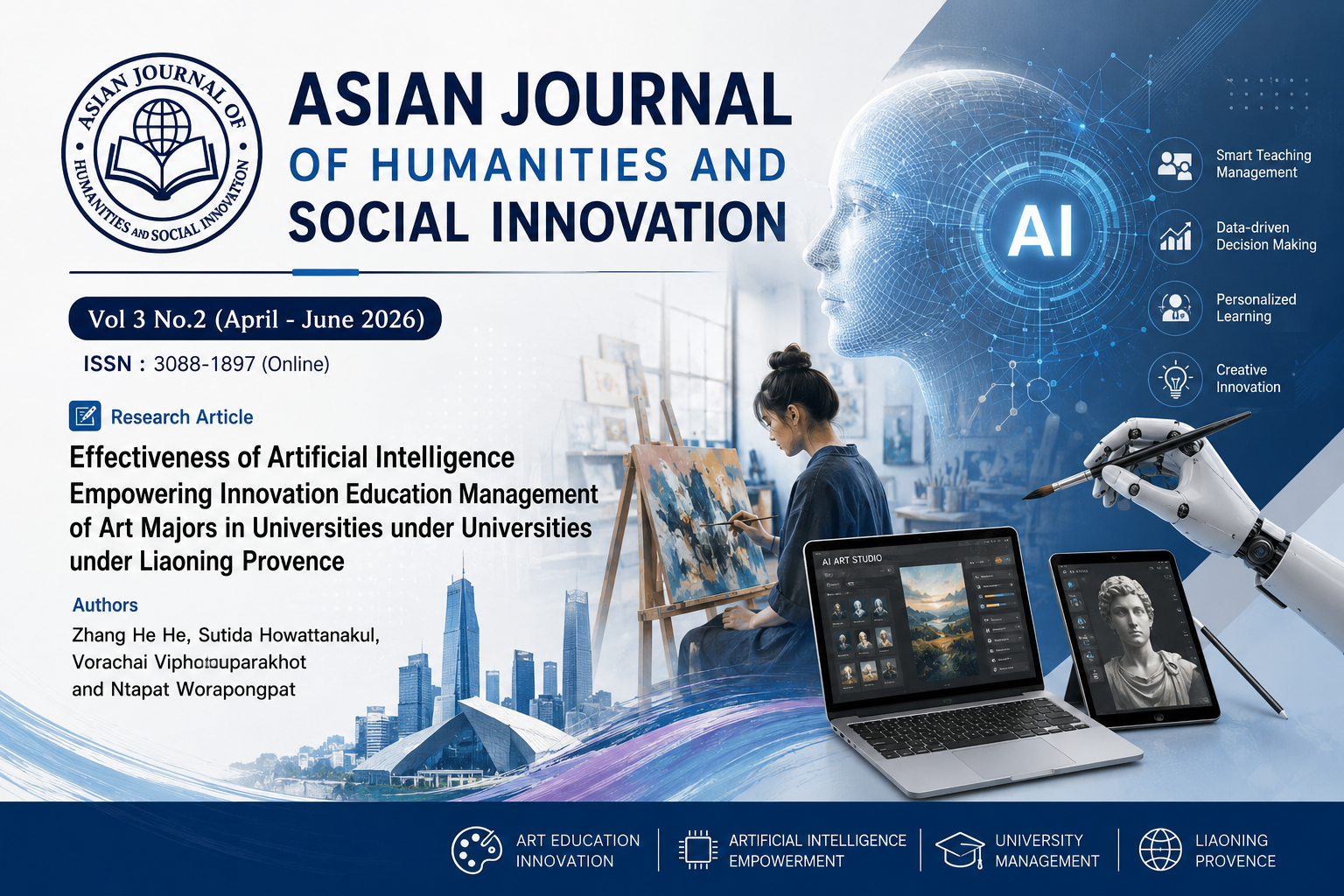
Effectiveness of Artificial Intelligence Empowering Innovation Education Management of Art Majors in Universities under Universities under Liaoning Provence
Keywords:
Effectiveness, Artificial Intelligence, Innovation Education Management, Art Majors, Universities in Liaoning ProvinceAbstract
This study develops a management framework to enhance the effectiveness of Artificial Intelligence (AI)-empowered innovation education management for art majors in universities in Liaoning Province, China. In response to the growing integration of AI technologies in higher education, particularly within creative disciplines, this research explores how AI can improve teaching innovation, educational management efficiency, and learner engagement. A mixed-methods research design was employed, integrating both quantitative and qualitative approaches. The target population consisted of 2,400 administrators, professors, and lecturers from five universities in Liaoning Province. A sample of 331 respondents was selected using stratified random sampling based on Krejcie and Morgan’s sampling framework. In addition, five key informants including university presidents, deans of art faculties, and program directors were purposively selected for in-depth interviews to provide qualitative insights. Data were collected using semi-structured interviews, a five-point Likert scale questionnaire, and focus group discussions. Quantitative data were analyzed using descriptive statistics and Exploratory Factor Analysis (EFA), while qualitative data were examined through content analysis.
The findings identified a total of 24 AI-based educational management guidelines, organized into six key domains: (1) AI technology application scope, (2) innovation in teaching and learning management, (3) educational management effectiveness, (4) autonomy of thinking and learner satisfaction, (5) government and institutional resource support, and (6) leadership styles for AI-enabled learning systems.
The study contributes both theoretical and practical insights into the integration of artificial intelligence in art education management. It provides a structured framework for improving educational innovation, enhancing institutional effectiveness, and supporting the modernization of higher education in Liaoning Province.
References
Adamopoulou, E., & Moussiades, L. (2020). An overview of chatbot technology. Machine Learning and Knowledge Extraction, 2(3), 235–265. https://doi.org/10.3390/make2030013
Adamopoulou, E., & Moussiades, L. (2020). Chatbots: History, technology, and applications. Machine Learning with Applications, 2, 100006. https://doi.org/10.1016/j.mlwa.2020.100006
Barbosa, P., & Oliveira, M. (2023). Fostering creativity in art education: Challenges and opportunities in higher education settings. International Journal of Education in the Arts, 24(1), 1–18.
Bouschery, S. G., Blazevic, V., & Piller, F. T. (2023). Enhancing human innovation teams with AI: An exploration of transformer-based language models. Journal of Product Innovation Management, 40, 139–153. https://doi.org/10.1111/jpim.12663
Kamalov, F. (2023). New era of artificial intelligence in education: Towards a sustainable multifaceted revolution. Sustainability, 15(16), 12451. https://doi.org/10.3390/su151612451
Hwang, G. J., & Chang, C. Y. (2021). A review of artificial intelligence applications in higher education: Challenges and opportunities. Educational Technology & Society, 24(1), 1–14.
Hwang, G. J., & Chang, S. C. (2021). A review of artificial intelligence-based learning environments in education: Opportunities and challenges. Educational Technology & Society, 24(1), 1–14.
Lee, K. C. (2021). The Lasater Clinical Judgment Rubric: Implications for evaluating teaching effectiveness. Journal of Nursing Education, 60(2), 67–73.
Leithwood, K., Harris, A., & Hopkins, D. (2020). Seven strong claims about successful school leadership revisited. School Leadership & Management, 40(1), 5–22. ttps://doi.org/10.1080/13632434.2019.1596077
Li, H. (2018). The impact and role of effective teaching methods on music education. Small and Medium Enterprise Management and Technology, 2(6), 80–81.
Lodge, J. M., Thompson, K., & Corrin, L. (2023). Framing generative AI research in higher education. Australasian Journal of Educational Technology, 39, 1–8.
Minn, S. (2022). Artificial intelligence-assisted knowledge assessment techniques for adaptive learning environments. Artificial Intelligence in Computer Education, 3, 100050.
Mousavinasab, E., Zarifsanaiey, N., Niakan, R., Kalhori, S., Rakhshan, M., Keikha, L., & Ghazi, S. M. (2021). Intelligent tutoring systems: A systematic review of characteristics, applications, and evaluation methods. Interactive Learning Environments, 29(1), 142–163.
Nicolescu, R., & Tudorache, M. (2022). AI in education: Potential and limitations. International Journal of Emerging Technologies in Learning, 17(5), 45–60.
Okonkwo, C. W., & Ade-Ibijola, A. (2021). A review of artificial intelligence applications in education. International Journal of Artificial Intelligence in Education, 31, 1–23.
Rombach, S., et al. (2022). AI technology in education: Data-driven decision-making and feedback systems. Journal of Educational Technology Research, 41(1), 98–110.
Selwyn, N. (2019). Should robots replace teachers? AI and the future of education. Learning, Media and Technology, 44(2), 111–126.
Stokel-Walker, C. (2022). ChatGPT and academic integrity: Risks and responses. Journal of Ethics in Education, 19(4), 112–125.
Wilcox, B. (2023). The impact of AI-generated content on academic honesty. Computers & Education, 180, 104534.
Williamson, B., & Eynon, R. (2020). Historical trends and contemporary debates on AI in education. Oxford Review of Education, 46(3), 235–252.
Wollny, S., Schneider, J., Di Mitri, D., Weidlich, J., Rittberger, M., & Drachsler, H. (2021). Are we there yet? A systematic literature review. Frontiers in Artificial Intelligence, 4, 654924. https://doi.org/10.3389/frai.2021.654924
Worapongpat, N. (2025a). Mindfulness in the use of artificial intelligence for learning among graduate students in private universities in Bangkok, Thailand. Asian Education and Learning Review, 3(2), 1–11. https://doi.org/10.14456/aelr.2025.6
Worapongpat, N. (2025b). The influence of artificial intelligence technology utilization and personnel's knowledge and competency in AI applications on work performance in local administrative organizations: A case study of Maha Sarakham Province. Nakhon Ratchasima Journal of Humanities and Social Sciences, 1(5), 72–93. https://so11.tci-thaijo.org/index.php/NJHSS/article/view/2705
Worapongpat, N. (2025c). Assessing essential needs for developing AI competencies among local administrative personnel toward smart local communities in Maha Sarakham Province. Journal of Academic and Research in Social Sciences, 1(4), 56–68. https://so13.tci-thaijo.org/index.php/J_ARSC/article/view/2925
Worapongpat, N., Dookarn, S., Boonmee, K., Thavisin, N., & Chanphong, S. (2025). The mindfulness in the use of artificial intelligence (AI) and its impact on learning for graduate students at private universities in Thailand. Journal of Intellect Education, 4(1), 97–109. https://so06.tci-thaijo.org/index.php/IEJ/article/view/278862
Worapongpat, N., Kangpheng, S., & Bhasabutr, P. (2026). Examining the relationship between AI competency and AI awareness among graduate-level instructors in private higher education institutions in Thailand. Journal of Education and Learning Reviews, 3(1), e2551. https://doi.org/10.60027/jelr.2026.e2551
Worapongpat, N. (2026a). A structural equation model of artificial intelligence capability and institutional sustainability performance under the ESG framework in private higher education institutions in Thailand. Lanna Academic Journal of Social Science, 3(1), 48–62. https://so13.tci-thaijo.org/index.php/LANNA/article/view/3624
Worapongpat, N. (2026b). The evolution of AI-driven marketing (2025–2026): Shifting from instrumental application to ecosystemic brand value: From Marketing 2025 to 2026: A comparative analysis of artificial intelligence in brand value creation and consumer engagement. Journal of Innovative Interdisciplinary Science, 4(1), 1–14. https://so15.tci-thaijo.org/index.php/jiis/article/view/3233
YongMing, C., Worapongpat, N., & Wongkumchai, T. (2024). Develop a sustainable competitive advantage strategy for financial business by using blockchain in banking industry. International Journal of Multidisciplinary in Educational & Cultures Studies (SITER), 2(1), 50–65.https://so04.tci-thaijo.org/index.php/ijec/article/view/270628
Ziyia, J., Wongkumchai, T., Soprakana, C., & Worapongpat, N. (2024). Assessing the role of AI-powered chatbots in improving customer experience in pharmaceutical e-commerce businesses in Beijing. RMUTT Global Business Accounting and Finance Review (GBAFR), 8(1), 31–48.
https://so01.tci-thaijo.org/index.php/GBAFR/article/view/271628
Zawacki-Richter, O., Marín, V. I., Bond, M., & Gouverneur, F. (2019). Systematic review of research on artificial intelligence applications in higher education: Where are the educators? International Journal of Educational Technology in Higher Education, 16(1), 1–27.
Downloads
Published
How to Cite
Issue
Section
License
Copyright (c) 2026 Asian Journal of Humanities and Social Innovation

This work is licensed under a Creative Commons Attribution-NonCommercial-NoDerivatives 4.0 International License.
This article is published under a Creative Commons Attribution-NonCommercial-NoDerivatives 4.0 International License (CC BY-NC-ND 4.0), which allows others to share the article with proper attribution to the authors and prohibits commercial use or modification. For any other reuse or republication, permission from the journal and the authors is required.