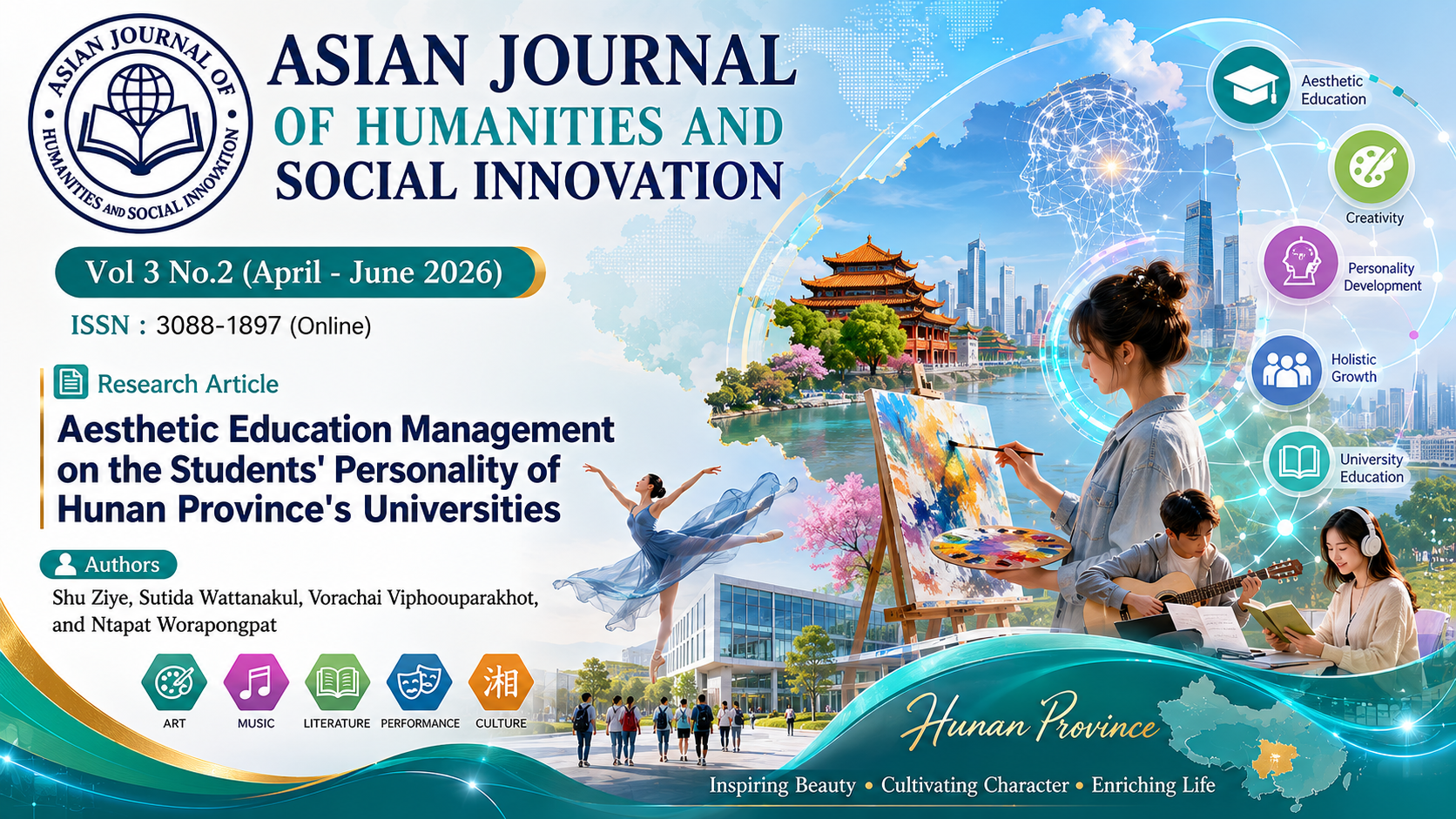
Aesthetic Education Management On The Students' Personality Of Hunan Province's Universities
Keywords:
Aesthetic Education Management, Students’ Personality, Hunan Province UniversitiesAbstract
This study aimed to: (1) explore the components of aesthetic education management influencing students’ personality development in universities in Hunan Province; and (2) develop managerial guidelines to enhance aesthetic education management in this context. A mixed-methods approach was employed, integrating both quantitative and qualitative research. The population consisted of 1,407 teachers from three universities in Hunan Province. A sample of 302 participants was determined using Krejcie and Morgan’s table and selected through stratified random sampling. Additionally, eleven key informants including administrators and faculty members were purposively selected for in-depth interviews. A focus group discussion (FGD) with nine experts was also conducted. Data collection instruments included a five-point Likert-scale questionnaire, a semi-structured interview guide, and an FGD protocol. Quantitative data were analyzed using frequency, percentage, mean, standard deviation, and exploratory factor analysis (EFA), while qualitative data were analyzed through content analysis. The findings revealed that aesthetic education management consists of five key components: (1) aesthetic education curriculum system construction, (2) impact on students’ personality development, (3) teacher roles and competencies, (4) aesthetic-oriented teaching methods and strategies, and (5) policy support and management mechanisms. Furthermore, the study developed 25 managerial guidelines grouped into five major categories, providing practical directions for enhancing aesthetic education management and supporting student personality development in universities in Hunan Province.
References
David, A., & Glore, P. (2010). The impact of design and aesthetics on usability, credibility, and learning in an online environment. Online Journal of Distance Learning Administration, 13(4), 43–50.
Du, W. (2022). Why do we need art today: An explanation on the humanistic value of classical art. Chinese Social Sciences, (05), 65–82, 205–206.
European Commission/EACEA/Eurydice. (2015). The European higher education area in 2015: Bologna process implementation report. Publications Office of the European Union.
Jin, X. (2009). Aesthetic education and personality development of students (Doctoral dissertation, Northeast Normal University).
https://kns.cnki.net/kcms/detail/detail.aspx?name=CDFD0911&filename=2009160628.nh
Kostov, B. (2013). On beauty and the beautiful in aesthetic education. International Journal of Cognitive Research in Science, Engineering and Education, 1(1), 71–75.
Sajnani, N., Mayor, C., & Tillberg-Webb, H. (2020). Aesthetic presence: The role of the arts in the education of creative arts therapists in the classroom and online. The Arts in Psychotherapy, 69, 101668. https://doi.org/10.1016/j.aip.2020.101668
Sun, M. H. (2021). A study on the good education of popular art education in colleges and universities: Taking public art courses and art clubs as an example. Musical Instrument, (12), 50–53.
The Ministry of Education of the People’s Republic of China. (2019). Ministry of education’s opinions on effectively strengthening aesthetic education in higher education institutions in the new era. Bulletin of the Ministry of Education of the People’s Republic of China, (05), 19–23.
Wang, M., & Zeng, F. R. (2017). The modernization construction of the great aesthetic education system in colleges and universities. China Higher Education, (07), 7–10.
Weiyi, W., Khamcharoen, N., & Worapongpat, N. (2024). Developing strategic guidelines to improve English language skills of vocational students in Linhai Taiyun vocational school, China. Journal of Public and Private Issues, 1(2), 84–93.
Wu, Q. (2023). Practical exploration of integration of college students' aesthetic literacy and ideological and political education for nurturing people. Century Bridge, (07), 65–67. https://doi.org/10.16654/j.cnki.cn23-1464/d.2023.07.028
Worapongpat, N. (2025a). The mindfulness in the use of artificial intelligence (AI) and its impact on learning for graduate students at private universities in Thailand. Journal of Intellect Education, 4(1), 80–92.
Worapongpat, N. (2025b). Building collaboration between schools and communities: A case study of multiple schools in Luoyang district. Journal of Education and Learning Reviews, 2(3), 95–104. https://doi.org/10.60027/jelr.2025.1097
Worapongpat, N. (2025c). Educational innovation management at Liaoning University. Chulalongkorn University Journal of Educational Administration and Innovation, 8(3), 1–12.
Worapongpat, N., & Arunyakanon, P. (2025). Transformational leadership and change management competency in response to sudden disruptions among administrators of Jiangling Town Central High School, Dazhou City. Journal of Education and Learning Reviews, 2(2), 47–58. https://doi.org/10.60027/jelr.2025.913
Worapongpat, N., Cai, Q., & Wongsawad, T. (2024). Creating and validating a digital leadership model for university teachers, Liaoning Province. Journal of Education and Learning Reviews, 1(3), 1–10. https://doi.org/10.60027/jelr.2024.740
Worapongpat, N., & Kangpheng, S. (2025). Transformational leadership skills for executives in the digital age, China Polytechnic College. Journal of Education and Learning Reviews, 2(5), 27–44.
Worapongpat, N., Khamcharoen, N., & Cong, W. (2024). Developing management guidelines for constructing curriculum of Chinese history subject for vocational college at Shangrao City Xinzhou Secondary Professional School, China. Journal of Public and Private Issues, 1(3), 219–229.
Worapongpat, N., & Xiaoling, H. (2024). Philosophical analysis of the establishment of university public relations at Guangdong Open University. Journal of Public and Private Issues, 1(3), 185–196.
Xu, H. S. (2018). Improving school aesthetic education: A study of major policies on school aesthetic education in the 40 years of reform and opening up. Journal of American Education, (06), 17–25.
Yasuttamathada, N., & Worapongpat, N. (2025). Leadership of organization administrators in an open university in China: A case study. Journal of Education and Learning Reviews, 2(1), 83–92. https://doi.org/10.60027/jelr.2025.930
Yanhong, A., & Alex, V. (2025). A development of training model for instructor’s career success at private undergraduate universities in Changsha City, China. Journal of Intellect Education, 4(4), 214–225.
Xinyu, W., Chanphong, S., & Jirarotephinyo, N. (2025). Educational management excellence team construction model for administrators in the new era of art universities in Dalian, Liaoning Province. Journal of Intellect Education, 4(5), 69–83.
Zhao, L. L. (2014). Aesthetic education: Education that makes personality perfect and harmonious. People’s Education, (21), 42–45.
Zhou, W., Worapongpat, N., & Liuyue, Z. (2024). Leadership according to the curriculum of teachers under the foundation of wisdom education: A case study of a primary school in Yin Chuan, China. International Journal of Multidisciplinary in Educational & Cultures Studies (SITER), 2(1), 15–28.
Downloads
Published
How to Cite
Issue
Section
License
Copyright (c) 2026 Asian Journal of Humanities and Social Innovation

This work is licensed under a Creative Commons Attribution-NonCommercial-NoDerivatives 4.0 International License.
This article is published under a Creative Commons Attribution-NonCommercial-NoDerivatives 4.0 International License (CC BY-NC-ND 4.0), which allows others to share the article with proper attribution to the authors and prohibits commercial use or modification. For any other reuse or republication, permission from the journal and the authors is required.