
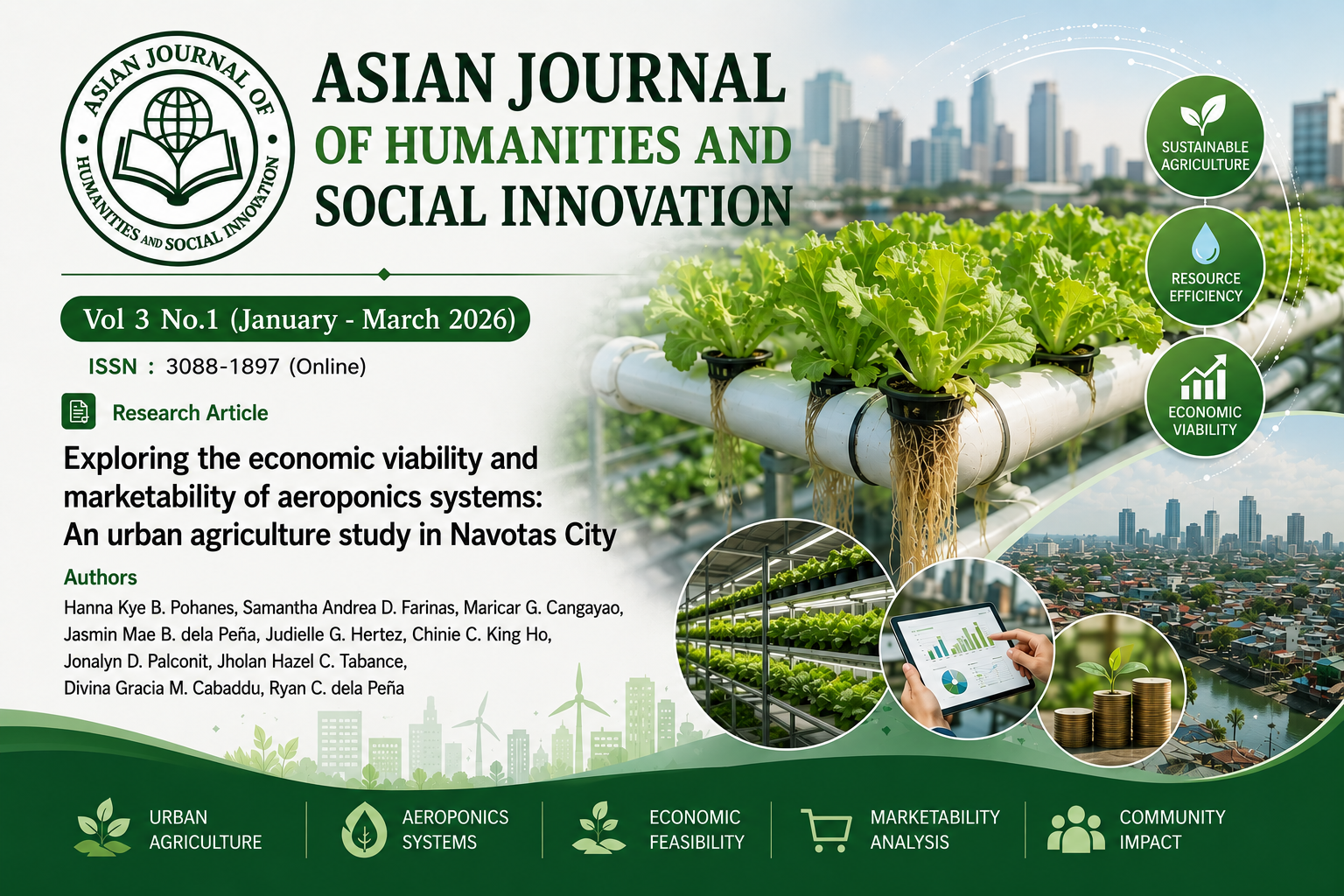
Exploring the economic viability and marketability of aeroponics systems: An urban agriculture study in Navotas City
Keywords:
aeroponics system, agriculture, business, economic viability, food security, sustainabilityAbstract
Aeroponics is an innovative soilless farming method increasingly recognized for its potential in urban agriculture. However, research on its economic and environmental viability remains limited, particularly in the Philippine context. This study explores the potential of aeroponics as a sustainable business model by focusing on its implementation in Navotas City. Using a qualitative approach, insights were gathered from individuals directly involved in operating aeroponics systems. Findings indicate that while aeroponics requires high initial investment, it offers notable benefits such as efficient resource use, scalability, and consistent high-yield production. These features suggest strong potential for profitability. Environmentally, the system reduces water usage and land requirements, supporting sustainable urban farming. Despite these advantages, challenges persist. Aeroponic produce, although marketable, often fails to meet specific weight standards required for sale. Additionally, energy consumption and high setup costs remain significant barriers to widespread adoption. In conclusion, aeroponics shows promise for increasing food production in space-constrained urban areas. However, for it to become a viable and scalable business model, further improvements in system efficiency and operational methods are needed. Future quantitative research is recommended to deepen the understanding of economic and environmental factors affecting its adoption in the Philippines.
References
Agritecture. (2021, August 11). 5 vertical farms to look out for in the Philippines. Retrieved from https://www.agritecture.com/blog/2021/8/11/5-vertical-farms-to-look-out-for-in-the-philippines
Airgarden. (n.d.). What is aeroponics? Retrieved from https://airgarden.com.au/blogs/news/what-is- aeroponics#:~:text=Closed%2Dloop%20aeroponics%3A%20This%20type,a%20stable%2C%20controll ed%20growing%20environment
Ares, G., et al. (2023). Buying vertically farmed produce: Comparison of people’s perceptions and acceptance. Journal of Sensory Studies.
Atlas Scientific. (n.d.). Advantages of aeroponics. Retrieved from https://atlas-scientific.com/blog/advantages-of- aeroponics/
Babbie, E. R. (2020). The Practice of Social Research (15th ed.). Cengage Learning.
Booker, J., & Booker, J. (2024, January 22). What are the disadvantages of aeroponics?. Chicago
Bucky, A., et al. (2026). Consumer attitudes towards vertical farming in Scotland. Food Quality and Preference.
Chu, S. W., et al. (2026). Advancing sustainable agriculture through aeroponics. Agriculture.
Creswell, J. W. (2014). Research Design: Qualitative, Quantitative, and Mixed Methods Approaches. (4th ed.). SAGE Publications.
Cultive Local. (n.d.). A solar-powered tower farm?. Retrieved September 10, 2025, from https://www.cultivelocal.com/en/a-solar-powered-tower-farm/December 16, 2024, from [https://growfoodinwater.com/what-are-the-economic-benefits-of-aeroponics]
Denzin, N. K., & Lincoln, Y. S. (2018). The SAGE Handbook of Qualitative Research. (5th ed.). SAGE Publications.
Eden Green article: Eden Green. (n.d.). Aeroponics vs hydroponics explained. Eden Green
Fei, S., et al. (2025). Technological innovations in urban and peri-urban agriculture. Horticulturae.
Garzón, J., et al. (2023). Systematic review of technology in aeroponics: Introducing the Technology Adoption and Integration in Sustainable Agriculture Model. Agronomy, 13(10), 2517.
Greater Noida Authority. (2025, May 24). Drop by drop: Greater Noida calls for ‘rain warriors’ to save parks, green belts. The Times of India. Retrieved September 10, 2025, from https://timesofindia.indiatimes.com/city/noida/drop-by-drop-greater-noida-calls-for-rain-warriors-to- save-parks-green-belts/articleshow/121384775.cms
Grow Food in Water. (n.d.). What are the economic benefits of aeroponics?. Retrieved https://www.laguardia.edu/majors/sustainable-urban-agriculture/
Grow Pod Solutions. (n.d.). Advantages of aeroponics. Retrieved December 16, 2024, from https://www.growpodsolutions.com/advantages-of-aeroponics
Havells Sylvania. (2024). Solar powered irrigation: Real costs and savings revealed. Retrieved September 10, 2025, from https://www.havells-sylvania.com/water-management-conservation/solar-powered- irrigation-real-costs-and-savings-revealed/
Inquirer.net. (2024, January 10). Urban farming takes root as a strategy for food security. Retrieved September 10, 2025, fromhttps://business.inquirer.net/493532/urban-farming-takes-root-as-a-strategy-for-food-security
Kazemian, A., et al. (2025). Synergistic food and energy production on urban rooftops: A city-scale framework for integrated photovoltaic-aeroponic systems. ScienceDirect.
Kluczkovski, A., et al. (2025). Urban vertical farming: Innovation for food security and social impact? Philosophical Transactions of the Royal Society B.
LaGuardia Community College. (n.d.). Sustainable urban agriculture.
Land Gardening. (2025). Chicagoland Gardening. Retrieved September 10, 2025, from https://chicagolandgardening.com/gardening-techniques/plant-care/what-are-the-disadvantages-of-aeroponics/
Macaso, M. E. P. (2025). The viability of hydroponic agriculture in tropical developing regions: A case study of Nueva Ecija, Philippines. Asian Journal of Agriculture and Rural Development, 15(2), 202–213.
Manila Standard. (2023, October 12). Urban farming option cultivates climate resilience and food security. Retrieved September 10, 2025, from https://manilastandard.net/spotlight/environmental-and-sustainability/314492090
Nadal, A. (2018). Rooftop greenhouses in educational centers. Their educational potential.
Navotas City Government. (2016–2025). Comprehensive Land Use Plan: Natural and Physical Profile.
Nicol, H. (2024, May 13). Navotas LGU inaugurates greenhouse facility. Manila Bulletin. Retrieved September 10, 2025, from https://mb.com.ph/2024/5/13/navotas-lgu-inaugurates-greenhouse-facility?utm_source
Nikam, S., Meshram, M., & Pawar, P. (2020). Aeroponics: A review on modern agriculture
Philippine Information Agency (PIA). (2023, July 28). Aeroponics and its climate-smart solution to food security. Retrieved September 10, 2025, from https://mirror.pia.gov.ph/features/2023/07/28/aeroponics-and-its-climate-smart-solution-to-food- security
Ramalingannanavar, N., Duraivadivel, P., Swamy, H. K., & Gireesh, S. R. (2020). Aeroponics: An advanced approach for vegetable cultivation. International Journal of Current Microbiology and Applied Sciences, 9(3), 2899-2908. Retrieved from https://www.ijcmas.com/9-3- 2020/Naganagouda%20Ramalingannanavar,%20et%20al.pdf
Rivera, X. S., et al. (2023). The role of aeroponic container farms in sustainable food systems: The environmental credentials. Science of the Total Environment.
Singha, A., et al. (2026). Exploring the feasibility of vertical aeroponic tower constructed from locally available materials for sustainable farming in Bangladesh. Bulletin of the National Research Centre.
Smith, J., & Lee, T. (2023). Evaluation of polycarbonate sheets for controlled environment agriculture. Agricultural Engineering Today, 45(2), 115–123. https://doi.org/10.1016/j.ageng.2023.04.005
Top Hydroponic Garden. (n.d.). Understanding the costs of aeroponics. Retrieved December 16, 2024, from https://tophydroponicgarden.com/understanding-the-costs-of-aeroponics
Vertical Farm Daily. (2020, November 3). Philippines: Partnership for aquaponics tech and center for urban agri. Retrieved from https://www.verticalfarmdaily.com/article/9257016/philippines-partnership-for- aquaponics-tech-and-center-for-urban-agri/i/.
VerticalFarmDaily. (2024, May 14). Philippines: Navotas inaugurates new source of organic produce.
Wang, C., Zhang, L., & Li, J. (2024). Advances in rotating vertical farms: Technologies and applications. Sustainability, 16(16), 7189. https://www.mdpi.com/2071-1050/16/16/7189
Wheeler, R. M., et al. (2024). Improving vertical farming efficiency through dynamic management. Frontiers in Science.
Yano, Y., et al. (2021). Consumer attitudes toward vertically farmed produce in Russia: A study using ordered logit and co-occurrence network analysis. Sustainability.
Yuan, G. N., et al. (2022). A review on urban agriculture: Technology, socio-economy, and policy. Heliyon.
Downloads
Published
How to Cite
Issue
Section
License
Copyright (c) 2026 Asian Journal of Humanities and Social Innovation

This work is licensed under a Creative Commons Attribution-NonCommercial-NoDerivatives 4.0 International License.
This article is published under a Creative Commons Attribution-NonCommercial-NoDerivatives 4.0 International License (CC BY-NC-ND 4.0), which allows others to share the article with proper attribution to the authors and prohibits commercial use or modification. For any other reuse or republication, permission from the journal and the authors is required.